

These AI reflection prompts for students help you write a detailed reflection in your own words, using ChatGPT, Gemini or another AI chatbot as a coach instead of a ghostwriter. You paste a prompt, fill in the brackets, and the AI asks you questions one at a time until you have enough real detail to write something your teacher will actually want to read.
Most lists of reflection prompts are written for teachers to hand out. This one is written for you. It covers tests, labs, essays, group projects, volunteer hours, guest speakers, art portfolios, internships and the end of the year. You’ll also find a before-and-after example of a weak and a strong reflection, a short guide to citing AI use, and a privacy checklist to read before you paste anything into a chatbot.
What are AI reflection prompts?
A reflection prompt is a question that makes you look back at something you did and figure out what it taught you. “What was hardest about this unit?” is a reflection prompt.
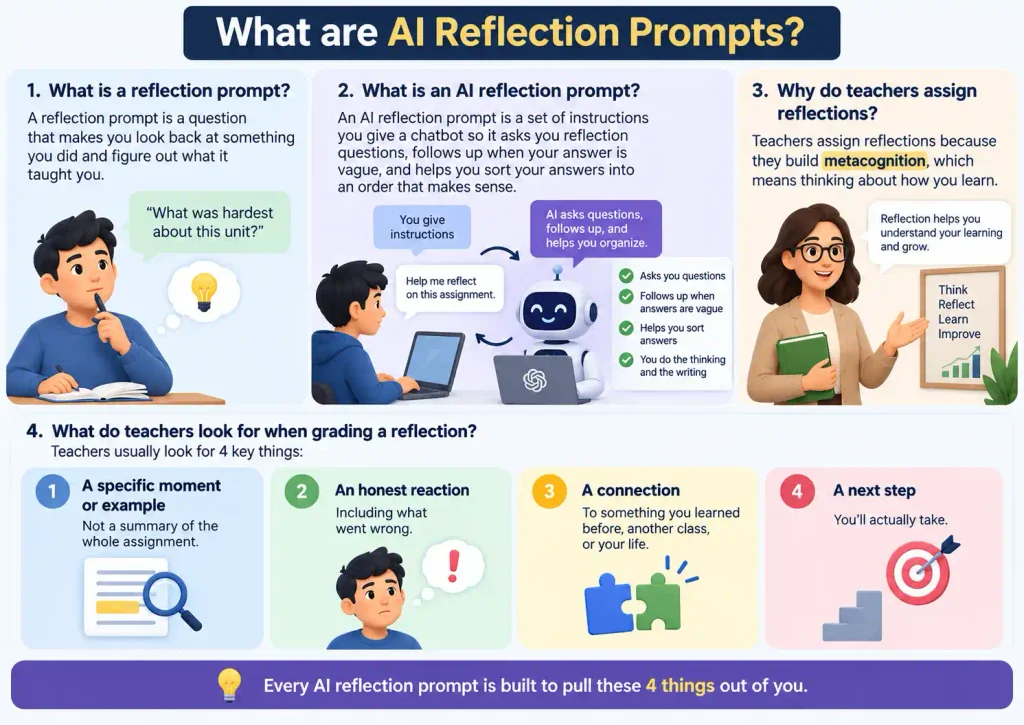
An AI reflection prompt is a set of instructions you give a chatbot so it asks you those questions, follows up when your answer is vague, and helps you sort your own answers into an order that makes sense. The AI does the asking. You do the thinking and the writing.
Teachers assign reflections because they build metacognition, which means thinking about how you learn. When teachers grade a reflection, they usually look for 4 things:
- A specific moment or example, not a summary of the whole assignment.
- An honest reaction, including what went wrong.
- A connection to something you learned before, another class, or your life.
- A next step you’ll actually take.
Every prompt below is built to pull those 4 things out of you.
The one rule: make the AI ask, not write
If a chatbot writes your reflection, it will sound smooth and general, and it will be missing the details that only you know. Many schools also count AI-written work as academic dishonesty unless your teacher allowed it.

So every prompt in this post tells the AI 3 things: ask 1 question at a time, don’t write the reflection for you, and push back when your answer is vague. Keep those lines in when you edit a prompt.
Prompt 1: The reflection coach (works for any assignment)
Act as my reflection coach. I need to write a reflection about [assignment or experience] for [class and grade level]. My teacher wants about [length, e.g., 300 words] and asked us to answer these questions: [paste your teacher’s questions].
Rules:
1. Ask me 1 question at a time and wait for my answer.
2. Do not write any part of my reflection for me.
3. If my answer is vague, like “it was good” or “I learned a lot,” ask a follow-up that pulls out a specific moment, example, number or feeling.
4. After about 8 questions, show me my own answers grouped under 3 headings: What happened, What I learned, What I’ll do next. Use my words. Only fix spelling.
Start with your first question.
Save this one. You can use it for almost anything, and the rest of the prompts are versions of it built for specific assignments.
Self-reflection prompts for students
Weekly reflections, learning logs and exit tickets are short, so they tend to get short answers. These 2 prompts help you get more out of 10 minutes.
Prompt 2: Weekly learning log
I’m writing my weekly learning log for [class]. This week we covered [topics]. Ask me these questions 1 at a time, and follow up if I’m vague:
– What’s 1 thing I can explain now that I couldn’t on Monday?
– Where did I get stuck, and what did I do when I got stuck?
– What question do I still have?
– Rate my understanding from 1 to 4 (1 = I need help to start, 4 = I could teach it) and explain the number.
Don’t write the log for me. At the end, list my answers in order so I can turn them into a paragraph.
Prompt 3: Connect new learning to what I already know
Today in [class] we learned [topic]. Help me connect it to things I already know. Ask me 1 question at a time:
1. What earlier topic or unit does this remind me of?
2. How is it the same, and how is it different?
3. Where might I see this outside school?
If my connection is weak or wrong, don’t correct it right away. Ask me a question that helps me find the problem myself. Don’t write my answer for me.
Reflection prompts after a test or quiz
Test corrections and test reflections are common in US middle and high school math and science, and they’re where vague answers like “I’ll study more” show up most. These prompts make you look at what went wrong, 1 problem at a time.
Prompt 4: Test error analysis
I got my [class, e.g., Algebra 1] test back. My score was [score]. Here are the problems I missed and what I wrote: [paste or describe each one].
Help me reflect. Do not solve the problems for me yet.
For each missed problem:
1. Ask me what I was thinking when I answered it.
2. Help me label the mistake as 1 of these: careless error, didn’t understand the concept, ran out of time, or didn’t study this part.
After all the problems, ask me which label showed up most, and what I’ll change before the next test. Then ask me to explain 1 corrected problem back to you in my own words, and tell me if my explanation has a gap.
Prompt 5: Study method check
I’m reflecting on how I studied for my [class] [test or quiz]. I studied by [what you did, e.g., rereading notes for 30 minutes the night before]. My result was [score].
Ask me 1 question at a time about:
– When I started studying and for how long
– What I did during that time (rereading, practice problems, flashcards, explaining it to someone)
– Which parts of the test felt easy and which felt hard
Then tell me, in 2 or 3 sentences, what research says about the study methods I used (for example, practice testing versus rereading), and ask me to pick 1 change for next time. Don’t write my reflection.
Reflection prompts for essays and writing assignments
Many US English and composition classes ask for a revision reflection or a “writer’s memo” with a final draft. These prompts help you explain your choices instead of just saying “I fixed my grammar.”
Prompt 6: Revision reflection
I revised my [type of essay] for [class]. Here is the feedback I got: [paste feedback]. Here is what I changed: [describe changes, or paste 1 before and 1 after paragraph].
Ask me 1 question at a time:
– Which piece of feedback was hardest to act on, and why?
– Show me 1 change I made and ask why I made it.
– Is there feedback I chose not to use? Why?
– What will I do differently from the first draft next time?
Don’t rewrite my essay or my reflection. Push back if I say something general like “it’s better now.”
Prompt 7: Writer’s memo
I need to write a short writer’s memo to go with my final draft of [essay title]. Interview me with 1 question at a time about:
1. What I was trying to argue or show
2. The part of the essay I’m proudest of and why
3. The part I’m least sure about
4. 1 question I want my teacher to answer when they grade it
Don’t write the memo. At the end, give me my answers as a numbered list so I can write the memo myself.
Science lab reflection prompts
Lab reflections usually lose points for 1 reason: “human error” as the only source of error. This prompt forces a specific answer.
Prompt 8: Lab report reflection
I’m writing the reflection or conclusion section for my [class] lab on [lab topic]. My hypothesis was [hypothesis]. My results were [key numbers or observations].
Ask me 1 question at a time:
1. Did my results support my hypothesis? What number shows that?
2. What’s 1 specific source of error in how we did the lab? (If I say “human error,” ask me what exactly the human did.)
3. How would that error change my numbers: higher, lower, or more spread out?
4. What would I change if I ran the lab again?
5. Where does this science show up in real life?
Don’t write my conclusion. At the end, list my answers so I can put them in paragraph form.
Group project reflection prompts
Group project reflections often ask you to rate yourself and your teammates. It’s easy to write “we worked well together” and stop. These prompts pull out what you actually did.
Prompt 9: My role and contribution
I’m reflecting on a group project for [class]: [project description]. There were [number] people in my group.
Ask me 1 question at a time:
– What exactly did I do? Ask for tasks, not adjectives.
– About how many hours did I spend on it?
– What’s 1 moment when I helped the group move forward?
– What’s 1 moment when I could have done more?
– What did I learn from watching a teammate work?
Don’t write my reflection, and don’t let me skip the “could have done more” question.
Prompt 10: Handling a group problem
My group had a problem during our [class] project: [describe it without using classmates’ real names]. Help me reflect on it fairly. Ask me 1 question at a time:
1. What happened, in order?
2. What did I do or say at each point?
3. How might the other person have seen it?
4. What worked and what didn’t when we tried to fix it?
5. What would I do in the first 10 minutes if this happened again?
Don’t take my side automatically. Ask questions that help me see the whole situation. Don’t write the reflection for me.
Service learning and volunteer reflection prompts
Many US high schools require service hours, and college service-learning courses almost always require written reflections. A common structure is “What? So What? Now What?”, a reflection model from Rolfe, Freshwater and Jasper (2001) that many service-learning programs use.
Prompt 11: What? So What? Now What?
I volunteered at [place] for [hours or dates] doing [tasks]. I need to write a reflection using What? So What? Now What?
Ask me questions 1 at a time in 3 rounds:
Round 1 (What?): What did I do and see? Ask for 1 specific moment.
Round 2 (So What?): Why did that moment matter? What did it make me think or feel? What did it change about how I see the issue or the people I served?
Round 3 (Now What?): What will I do next because of this, and when?
Don’t move to the next round until I’ve given at least 1 specific detail. Don’t write the reflection for me.
Prompt 12: Checking my assumptions
Before volunteering at [organization], I expected [what you expected]. After [hours], here’s what I noticed: [notes].
Ask me 1 question at a time to help me compare what I expected with what I saw. Ask where my first expectations came from. If I describe the people I served in a way that sounds like a stereotype, point it out gently and ask me to describe them more specifically. Don’t write my reflection.
Reflection prompts after a lecture, guest speaker or reading
Colleges often assign reflections after a convocation speaker, a lecture or a reading. The goal is to respond to the ideas, not summarize them. These prompts keep you from writing a summary.
Prompt 13: Guest speaker or lecture reflection
I attended a talk by [speaker] about [topic] for [class]. My notes: [paste notes].
Ask me 1 question at a time:
1. What was the speaker’s main claim, in 1 sentence?
2. What evidence or story did they use to support it?
3. Where do I agree, and where do I disagree or have doubts?
4. How does this connect to something from our class readings?
5. What’s 1 question I would ask the speaker?
If I start summarizing the whole talk, stop me and ask for my own view. Don’t write my reflection.
Prompt 14: Reading response
I read [title and author] for [class]. Help me write a reading response. Ask me 1 question at a time:
– Which passage stuck with me? Ask me to quote or point to it.
– Why that passage?
– What did the author want readers to think or feel there?
– Did anything confuse me or bother me?
– How does this reading connect to [another reading, a current event, or my own life]?
Don’t summarize the reading for me, and don’t write my response.
Art and portfolio reflection prompts
Art classes often ask for an artist statement, a process journal or an exhibition rationale. In IB Diploma Visual Arts, for example, students write a curatorial rationale that explains how their exhibition pieces were chosen and arranged. The same questions help with any portfolio.
Prompt 15: Artist statement or exhibition reflection
I’m writing a reflection for my [art class, portfolio or exhibition]. My pieces are: [list each piece with title, medium and a 1-line description].
Ask me 1 question at a time:
1. What idea or question connects these pieces?
2. For each piece: what choice about material, color or size was on purpose, and why?
3. How did I decide the order or layout?
4. Which piece changed the most from my first sketch, and what caused the change?
5. What do I want a viewer to notice first?
Don’t write my statement. At the end, list my answers under each piece so I can write it myself.
End of semester and end of year reflection prompts
End-of-year reflections cover months of work, so it’s hard to know where to start. These prompts help you pick real moments instead of writing “this year I grew a lot.”
Prompt 16: Semester look-back
I’m writing an end-of-semester reflection for [class]. Here are the units or big assignments we did: [list].
Ask me 1 question at a time:
– Which assignment am I proudest of, and what did I do on it that I couldn’t do in August?
– Which one was hardest, and what did I do about it?
– What’s 1 habit I built or broke this semester?
– What’s 1 thing from this class that no one else would describe the same way I would?
Push for dates, grades or specific examples. Don’t write the reflection for me.
Prompt 17: Goals for next semester
Based on this semester in [class or overall], help me set 2 goals for next semester. Ask me 1 question at a time about what went well and what didn’t. Then help me turn each goal into something specific and measurable, with a date I’ll check on it. Don’t pick the goals for me; ask questions until I pick them.
Reflection prompts for internships and college applications
Internship reflections and college essays both need specific stories. These prompts help you find the details. Check each college’s policy on AI before you use AI for application essays, since some ask applicants to confirm the essay is their own work.
Prompt 18: Weekly internship reflection
I’m an intern at [type of organization]. This week I worked on [tasks]. Ask me 1 question at a time:
– What’s 1 task I did better this week than last week?
– What’s 1 thing I didn’t know how to do, and how did I figure it out?
– What did I notice about how people at work communicate?
– What skill from school did I use?
Don’t write my log. At the end, list my answers with the date so I can keep a record for my final report.
Prompt 19: Finding a story for a college essay
I’m brainstorming for a college essay on this prompt: [paste the essay prompt]. Don’t write any part of the essay.
Ask me 1 question at a time to help me find 3 possible stories from my life. For each story, ask for:
– 1 specific scene (where I was, what happened, what someone said)
– What I thought or felt in that moment
– What I believe now that I didn’t before
At the end, list the 3 stories with my details so I can choose 1.
AI use reflection prompts: reflecting on how you used AI
More teachers now ask students to reflect on how they used AI during an assignment. College teaching centers, like Kent State’s, share question lists for before, during and after AI use. This prompt helps you answer those questions from your own notes.
Prompt 20: AI use reflection
My teacher asked me to reflect on how I used AI on [assignment]. Here’s what I did: [e.g., “I asked ChatGPT to explain photosynthesis in simpler words and to check my spelling”].
Ask me 1 question at a time:
1. Was I allowed to use AI this way in this class?
2. What did AI help with, and what did I do without it?
3. Did I check any facts the AI gave me? How?
4. Which ideas and sentences in my final work are fully mine?
5. Did using AI help me learn the material, or did it skip a step I needed?
Don’t write my answer. At the end, help me list my answers so I can write a short AI use statement myself.
What a detailed reflection looks like: before and after
Most “write more detail” feedback doesn’t show you what detail looks like. Here’s the same group project reflection written 2 ways.
Before (vague):
Our group project went well. We worked together and I learned a lot about teamwork. I also learned about water quality. Next time I will manage my time better.
It’s 36 words, and none of them tell the teacher anything they didn’t already know.
After (detailed, using What? So What? Now What?):
What: For our AP Environmental Science water quality poster, I tested pH at 3 sites along a creek near school and built our data table. Two days before the deadline, I noticed 2 of our sample bottles had been labeled wrong, so the pH readings for sites 2 and 3 were swapped.
So what: I was frustrated, because it meant redoing our graph the night before we printed. Once the data was fixed, our conclusion changed: the site below the storm drain had the lowest pH, which matched what we’d read about runoff. Checking labels took about 5 minutes, and it changed our whole result.
Now what: On our next lab, I’ll label each bottle and write the label in my notebook at the same time. I’ll also ask a partner to check the data table before anyone starts graphing.
Here’s what changed:
- A specific moment replaced “it went well”: the swapped labels 2 days before the deadline.
- Numbers replaced general words: 3 sites, 2 bottles, 5 minutes.
- The feeling has a cause: frustrated because of redoing the graph.
- The next step is an action, not a wish: label and record at the same time, and ask a partner to check.
Detail check prompt (use it on any draft):
Here is my reflection draft: [paste draft]. Don’t rewrite it.
1. Mark each sentence that is vague or general.
2. For each 1, ask me 1 question that would help me add a specific detail.
3. Tell me which part is weakest: What happened, So what, or Now what.
How to disclose and cite AI in your reflection
If your teacher allows AI, you’ll usually need to say how you used it. Check your syllabus first; if it has its own format, use that.
A simple AI use statement you can adapt:
AI use statement: I used [tool and model] on [date] to [ask me reflection questions / check my spelling]. The ideas, examples and wording in this reflection are my own. I did not use AI to write sentences or come up with examples. My chat is available at [shareable link].
MLA style. MLA’s updated guidance from 2025 says to describe the prompt, name the tool, put the model name in the version spot, and use a shareable link to the chat if the tool has one:
“Ask me 1 question at a time to help me reflect on my chemistry lab” prompt. ChatGPT, [model name], OpenAI, 14 Sept. 2026, [shareable chat link].
MLA also says to acknowledge functional uses, like editing or translating, in a note or in your text.
APA style. APA lists the company as the author and treats the chatbot as software:
OpenAI. (2026). ChatGPT ([model or version]) [Large language model]. https://chatgpt.com
In-text: (OpenAI, 2026). APA also suggests adding the full chat as an appendix when the exact wording matters.
Keep your chat history. Your saved chat shows your process: the AI asked, you answered. If a teacher ever asks how you wrote your reflection, that record is the clearest answer you can give.
Before you paste anything: privacy and age rules
Reflections are personal, so it’s easy to share more than you should. Check these before you use any of the prompts above.
Age rules. ChatGPT requires users to be at least 13, and users under 18 need a parent or guardian’s permission. Claude’s consumer app requires users to be 18 or older. Other tools have their own rules, so check before you sign up.
Use your school’s tool if there is one. Many US districts approve specific AI tools after reviewing them against student privacy laws like FERPA. A school account is usually safer than a personal one for schoolwork.
Leave these out of any prompt:
- Your full name together with your school’s name
- Grades, test scores or report cards you haven’t been asked to share
- IEP, 504 plan, health or counseling details
- Classmates’ names or anything private about them (use “Teammate A” instead)
- Photos of other students
Turn off training if you’re using a personal account. ChatGPT lets you turn off the setting that allows your chats to be used for model training, under Data Controls in Settings.
FAQ
Is using AI for a reflection assignment cheating?
It depends on your teacher’s policy. Having AI ask you questions is very different from having AI write your answer, but only your teacher can say what’s allowed. If the syllabus doesn’t say, ask before you start.
Can my teacher tell if AI wrote my reflection?
AI detectors are not reliable; OpenAI shut down its own AI text classifier in 2023 because of low accuracy. Teachers usually notice something else: a reflection with no specific moments, no mistakes and no personal details. A reflection built from your own answers won’t have that problem.
How long should a student reflection be?
Follow your teacher’s length. If there isn’t one, 250 to 400 words is enough for most class reflections, as long as it covers what happened, what you learned and what you’ll do next.
Which AI tool is best for reflection prompts?
Any chatbot that follows instructions works: ChatGPT, Gemini, Copilot or your school’s approved tool. The rules in the prompt matter more than the tool.
What if the AI starts writing my reflection anyway?
Reply with: “Stop. Don’t write any part of my reflection. Go back to asking me 1 question at a time.” Then continue.
Also Read: