Job hunting eats time before it eats confidence. You rewrite the same resume for 10 different job posts, copy-paste the same cover letter with a new company name swapped in, and walk into interviews without a real practice round. Most of that work can be handed to ChatGPT if you know what to ask for.
I started testing ChatGPT prompts for job seekers after watching friends spend entire weekends tailoring resumes by hand for roles they didn’t even get shortlisted for. The pattern was always the same: vague prompts like “improve my resume” got vague output. The moment the prompt named the job title, the industry, the experience level (fresher, 12th pass, career switcher, or 5 years experienced), and the exact outcome needed, the output turned from generic filler into something you could actually submit.
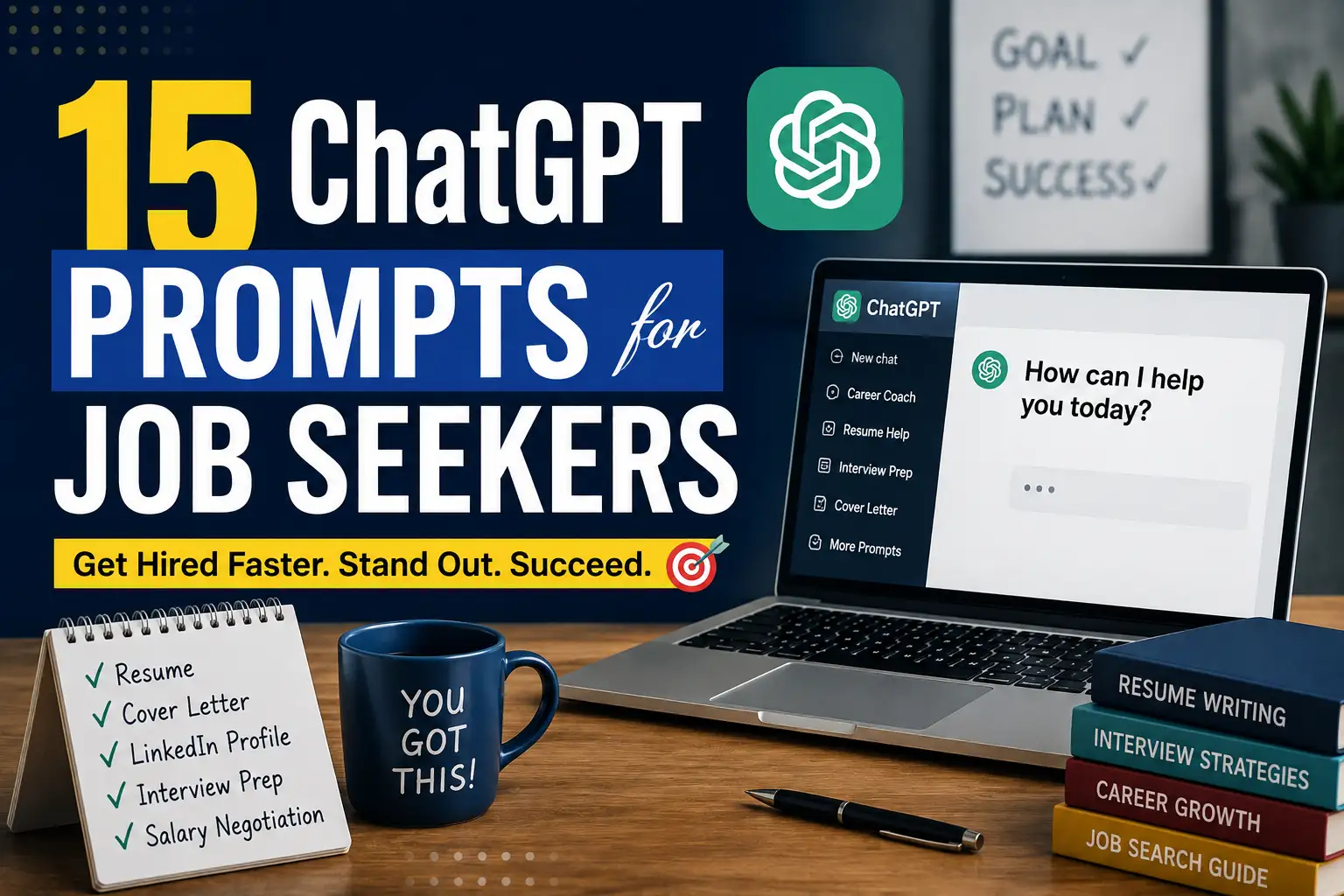
This guide has 15 prompts, split across resumes, cover letters, interviews, networking, and long-term career growth. Every prompt is written for real use, not a demo. Fill in your job title, company, or job description where marked, and run it as is.
Resume prompts for freshers, 12th pass, and experienced job seekers
1. ATS-friendly resume rewrite (resume prompts for freshers and 12th pass candidates)
Act as a resume writer who specializes in ATS-friendly resumes for [experience level: 12th pass / fresher / 2-5 years experienced / career switcher]. Job title I’m applying for: “[job title]”. Industry: “[industry]”.
My current resume content: [paste resume text or bullet points].
Rules:
1. Rewrite this to pass ATS scanning software: use standard section headers (Summary, Skills, Experience, Education), no tables, no graphics-dependent formatting.
2. Rewrite each bullet point using the format: action verb + what I did + measurable result. If I have no numbers, ask me 2 questions to help me find a number instead of inventing one.
3. Pull the 8 to 10 keywords this job title usually requires and confirm which ones I already have versus which ones are missing.
4. Keep the resume to 1 page if I have under 3 years of experience, 2 pages max otherwise.
5. Flag any line that sounds generic or copied from a template, and rewrite it to sound specific to me.
2. Resume for no work experience (resume prompts for 12th pass and first-time job seekers)
Act as a career coach for candidates with no formal work experience. I’m a [12th pass student / fresh graduate] applying for “[job title]”.
Here’s what I have instead of a job history: [list internships, college projects, volunteering, freelance work, certifications, or skills, even informal ones].
Rules:
1. Build a resume structure that leads with Skills and Projects instead of Experience, since I don’t have a long work history.
2. Turn each project or activity I listed into a bullet point with a real outcome, not just a description of what it was.
3. Suggest 3 free certifications or short courses relevant to “[job title]” that would strengthen this resume within 30 days.
4. Do not pad the resume with soft-skill buzzwords like “hardworking” or “team player” unless backed by a specific example.
5. Give me a 1-line resume summary that explains why I’m a strong candidate despite no formal experience.
3. Resume tailored to a specific job description
Act as a recruiter who has hired for this exact role before. Job description: [paste full JD]. My resume: [paste resume text].
Rules:
1. Compare my resume against this JD line by line and list what’s missing: skills, tools, keywords, or experience types the JD asks for that my resume doesn’t show.
2. Rewrite my top 5 bullet points to mirror the language this JD uses, without lying about what I actually did.
3. Score my resume’s match to this JD out of 100, and explain what’s costing me the most points.
4. Suggest which 2 bullet points I should cut entirely because they’re irrelevant to this specific role.
5. Give me a rewritten professional summary, 3 lines max, built specifically for this JD.
Cover letter prompts for ChatGPT that don’t sound generic
4. Personalized cover letter based on the job post
Act as a hiring manager who reads 50 cover letters a week and can spot a copy-paste one instantly. Job title: “[job title]” at “[company name]”. Job description: [paste JD]. My background: [paste 2-3 lines about your relevant experience].
Rules:
1. Write a cover letter under 300 words, 3 short paragraphs: why this role, why me, why this company specifically.
2. Reference something specific about the company (product, mission, recent news) I mention below, don’t invent details: [paste 1 fact about the company or say “research and suggest 1 relevant point”].
3. Avoid these overused opening lines: “I am writing to express my interest,” “I saw your job posting on,” “I am excited to apply.”
4. Match the tone to the company: formal for corporate/finance roles, conversational for startups, unless I say otherwise.
5. End with a specific next step, not a generic “I look forward to hearing from you.”
5. Cold application cover letter (no job posting exists)
Act as a career strategist. I want to apply to “[company name]” even though I don’t see an open role matching “[job title]”. My background: [paste 2-3 lines].
Rules:
1. Write a short cover letter, 200 words max, that explains why I want to work at this specific company, not just “any company in this industry.”
2. Suggest 1 way to reference a real, specific reason this company might need someone like me right now, based on what I tell you about their recent work: [paste any news, product launch, or expansion you know about, or ask me].
3. Include a clear, low-pressure ask: informational chat, resume on file, or referral to the right person, not a hard pitch for a job that doesn’t exist.
4. Keep the tone confident, not desperate. Flag any line that sounds like begging.
6. Cover letter shortener and tone fixer
Act as an editor. Here’s my cover letter draft: [paste draft].
Rules:
1. Cut it to under 250 words without losing the 2 strongest points.
2. Point out any sentence that repeats what’s already in my resume without adding new information, and remove it.
3. Flag overly formal or robotic phrases and suggest a more natural replacement.
4. Check that the opening line doesn’t restate the job title in a boring way, rewrite it if it does.
5. Give me the final version, ready to paste, not just a list of suggestions.
Interview preparation prompts for freshers and experienced candidates
7. Mock interview simulation
Act as the hiring manager interviewing me for “[job title]” at “[company name or industry type]”. Interview round: [screening call / technical round / final round].
Rules:
1. Ask me 1 question at a time, wait for my answer before asking the next one.
2. Base the questions on what’s actually asked for this role and round, not generic interview questions.
3. After each answer, give me quick feedback: what was strong, what was missing, and how to tighten the answer.
4. Include at least 2 tricky or unexpected questions I might not be prepared for.
5. At the end, give me an overall readiness score out of 10 and the top 2 things to fix before the real interview.
8. STAR-method answer builder for behavioral questions
Act as an interview coach. Behavioral question: “[paste the question, e.g. Tell me about a time you handled conflict at work]”. My rough answer or situation: [paste your notes, even messy ones].
Rules:
1. Turn my notes into a clear STAR-format answer: Situation, Task, Action, Result, each 1-2 sentences.
2. Push me for a specific, measurable result if I haven’t given one, don’t accept a vague ending.
3. Keep the full answer under 90 seconds if spoken out loud.
4. Flag if my “Action” section talks about what the team did instead of what I personally did.
5. Give me 1 shorter version for a quick screening call and 1 fuller version for a final-round interview.
9. Salary negotiation script
Act as a salary negotiation coach. Role: “[job title]”. Offer received: [salary/CTC offered]. Market range I’ve researched: [range, or ask me to help find it]. My leverage: [competing offer, years of experience, in-demand skill, or none].
Rules:
1. Write a short script I can use on a call to negotiate, not just bullet points of tips.
2. Base the ask on my actual leverage, don’t suggest an aggressive number if I have no competing offer or strong leverage.
3. Include 1 line for negotiating non-salary items (joining bonus, remote days, review timeline) in case the base salary is fixed.
4. Give me a fallback response in case they say no, so I don’t go silent or panic on the call.
5. Keep the tone confident and collaborative, not confrontational.
AI prompts for networking and LinkedIn
10. LinkedIn profile optimization
Act as a LinkedIn profile strategist. Target role: “[job title]”. My current headline and about section: [paste current text, or say “I don’t have one yet”].
Rules:
1. Write a headline under 220 characters that includes what I do, who I help, or what result I deliver, not just my job title.
2. Rewrite my About section: hook in the first line, 3-4 short paragraphs, end with what I’m looking for next.
3. Suggest 5 skills to pin to my profile based on “[job title]”, ranked by what recruiters search for most.
4. Flag anything in my current profile that sounds like a resume copy-paste instead of a real profile.
5. Give me 1 line I can use as a custom LinkedIn connection request message tied to this target role.
11. Cold outreach message to a recruiter or employee
Act as a networking coach. I want to message [a recruiter / an employee] at “[company name]” about “[job title / just exploring opportunities]”. Here’s what I know about them: [their role, or say “I don’t know much, just found them on LinkedIn”].
Rules:
1. Write a connection request note under 300 characters, specific enough that it doesn’t look like a mass message.
2. Write a short follow-up message, under 100 words, to send after they accept, that asks for something small (a 15-minute chat, advice, a referral) not a job directly.
3. Do not use generic lines like “I’d love to pick your brain” or “I came across your profile.”
4. Give me 1 alternate version in case this person doesn’t respond within a week.
12. Informational interview request
Act as a career coach. I want to request a short informational chat with someone working as “[their job title]” at “[company name]” to learn about “[what you want to learn: the role, the company, breaking into the industry]”.
Rules:
1. Write a message under 120 words asking for 15-20 minutes of their time, respectful of the fact that they don’t owe me anything.
2. Include a specific reason I’m asking them and not someone else, based on what I tell you about their background: [paste 1-2 lines about them].
3. Suggest 5 good questions to ask during the call that go beyond “any tips for me,” specific enough to get useful answers.
4. Write a short thank-you message template to send after the call.
Career growth and job search strategy prompts
13. Skill-gap analysis against a target job
Act as a career advisor. Target role: “[job title]” in “[industry]”. My current skills and experience: [paste a summary].
Rules:
1. List the skills or tools this role typically requires that I don’t currently have.
2. Rank the gaps by how hard they are to fix: quick to learn (under 30 days), medium (1-3 months), long-term (6+ months).
3. For each quick-to-fix gap, suggest 1 specific free or low-cost resource to close it.
4. Tell me honestly if this target role is realistic within 3 months given my current background, or if I should target a step in between first.
14. 30-60-90 day job search plan
Act as a job search coach. I’m targeting “[job title]” roles in “[location or remote]”. I can spend [X hours per week] on the job search. Current status: [just starting / applied to some roles / getting interviews but no offers].
Rules:
1. Build a 30-60-90 day plan: what to focus on in each phase (resume/profile setup, applications, networking, interview prep), not just “apply to more jobs.”
2. Include a weekly target for applications, networking messages, and skill-building, based on the hours I have available.
3. If my status shows I’m getting interviews but no offers, focus the plan more on interview prep and less on applications.
4. Include 1 checkpoint at day 30 and day 60 to review what’s working and adjust.
15. Career path mapping for long-term growth
Act as a career strategist. My current role: “[current job title]”. Where I want to be in 5 years: “[target role or industry, or say “not sure yet”]”.
Rules:
1. Map 2-3 realistic paths from my current role to that target, showing the typical next 1-2 job titles along each path.
2. For each path, list the 1 or 2 skills that matter most to move to the next step.
3. If I said “not sure yet,” ask me 3 questions about what I like and dislike in my current role before suggesting paths.
4. Flag if my current role is a weak starting point for my stated goal, and suggest what to fix first.
Practical tips to find a job faster (beyond AI prompts)
AI prompts fix the writing and prep side. These fix the search itself.
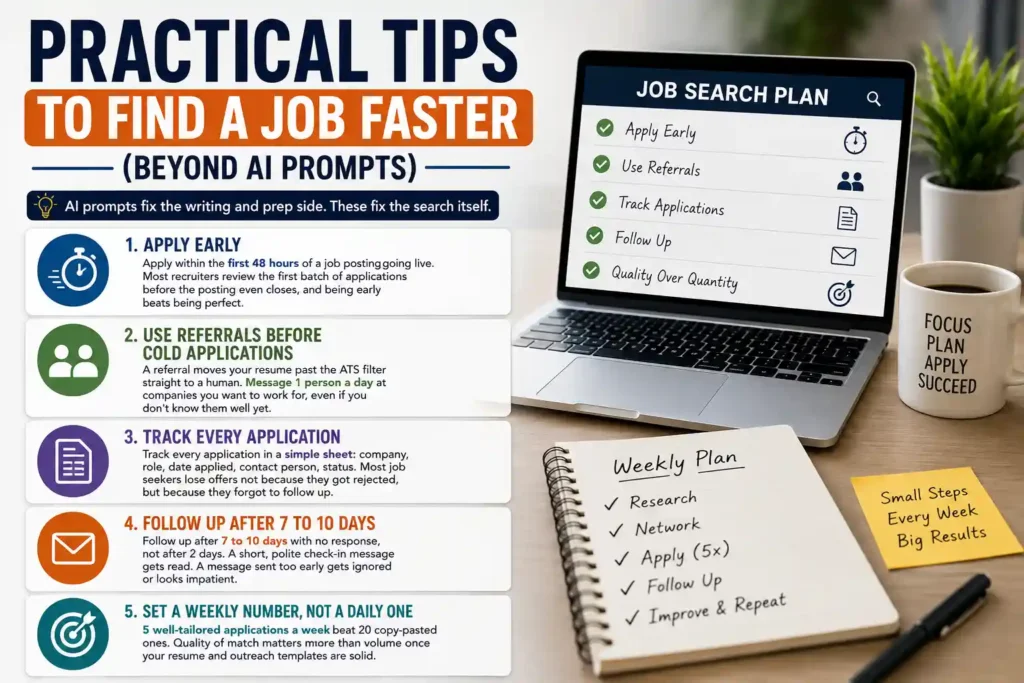
Apply within the first 48 hours of a job posting going live. Most recruiters review the first batch of applications before the posting even closes, and being early beats being perfect.
Use referrals before cold applications. A referral moves your resume past the ATS filter straight to a human. Message 1 person a day at companies you want to work for, even if you don’t know them well yet.
Track every application in a simple sheet: company, role, date applied, contact person, status. Most job seekers lose offers not because they got rejected, but because they forgot to follow up.
Follow up after 7 to 10 days with no response, not after 2 days. A short, polite check-in message gets read. A message sent too early gets ignored or looks impatient.
Set a weekly number, not a daily one. 5 well-tailored applications a week beat 20 copy-pasted ones. Quality of match matters more than volume once your resume and outreach templates are solid.
Conclusion
A better resume or a sharper interview answer won’t get you hired on their own, they just remove the reasons a recruiter says no. Use the resume and cover letter prompts before you apply, the interview and networking prompts once you’re in the process, and the career growth prompts to plan your next move after you land the role. Start with prompt 1 or 3 today, tailor it to a real job you want, and send that application before the day ends.