Hi, I’m Keshav Chouhan, and I spend a lot of time testing ChatGPT prompts for students preparing for board exams and competitive exams. I regularly share practical AI study prompts, revision templates, and prompt collections that help students study smarter without wasting hours on notes that don’t stick.
Lately, AI prompts for exam preparation have picked up fast across student WhatsApp groups, Telegram channels, and Instagram study pages. Every week thousands of students are using ChatGPT and Claude to build revision sheets, generate MCQs, get answers checked, and plan their last few study days before an exam.
The reason some students get sharp, exam-ready output while others get vague, textbook-style answers isn’t the AI model, it’s the prompt. Small details like naming the exact exam, setting a word limit, asking for a marking-scheme-style evaluation, or telling the AI not to repeat questions change the output completely.
To shortlist the best ones, I tested these ChatGPT prompts for students across different subjects, exam types, and revision stages: fresh chapters, half-done syllabus, and 1-day-left situations. After running them across NEET, JEE, UPSC, CBSE boards, and a few other exams, I kept only the prompts that consistently gave usable, accurate, exam-focused results.
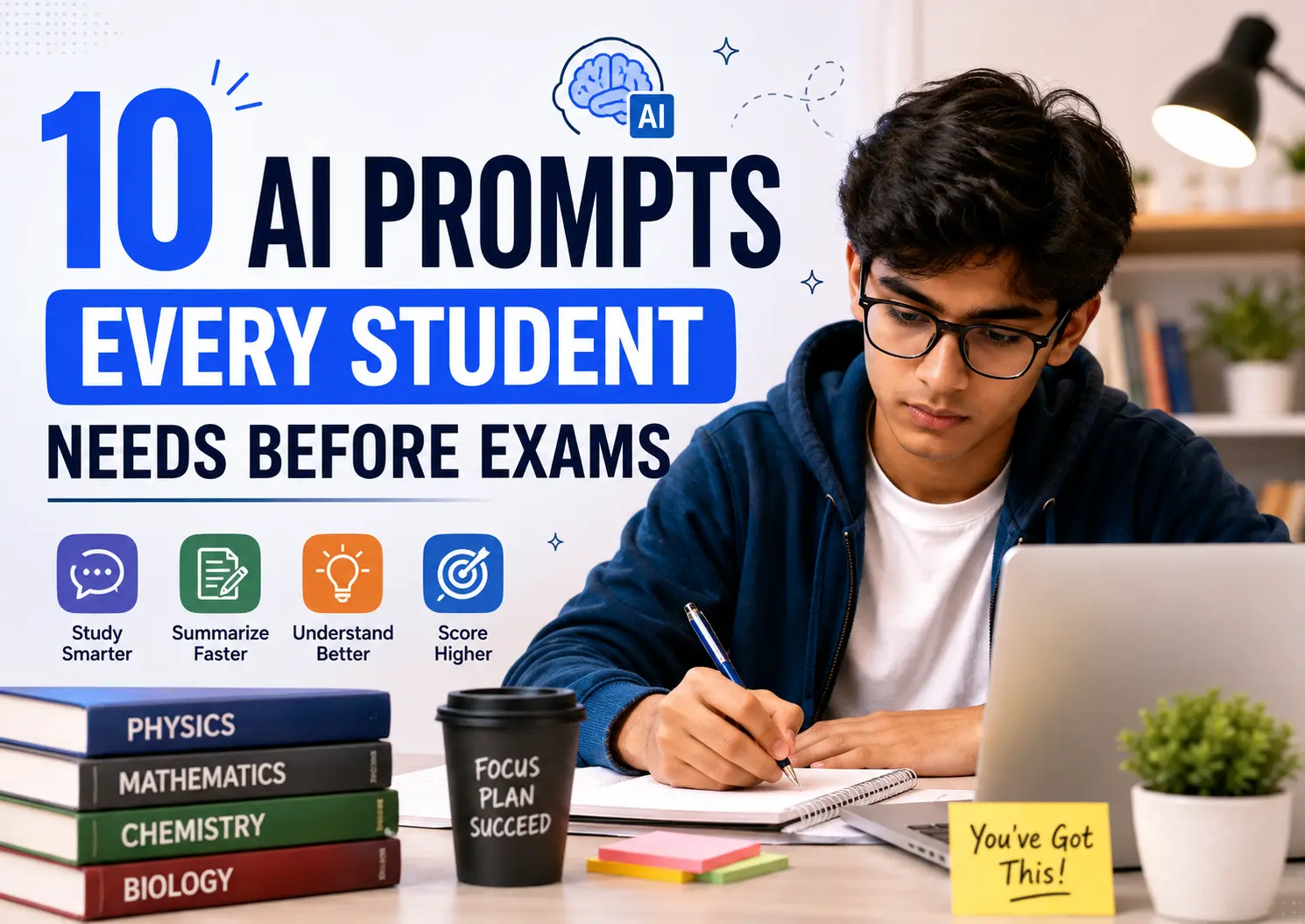
In this guide, you’ll find 10 AI prompts every student needs before exams, plus a dedicated prompt for 10 popular exams.
Note: Just paste the prompt into ChatGPT or Claude, fill in your subject, topic, or exam name in the brackets, and run it.
10 AI study prompts for students before exams
1. Chapter summary prompt for best AI-assisted exam revision
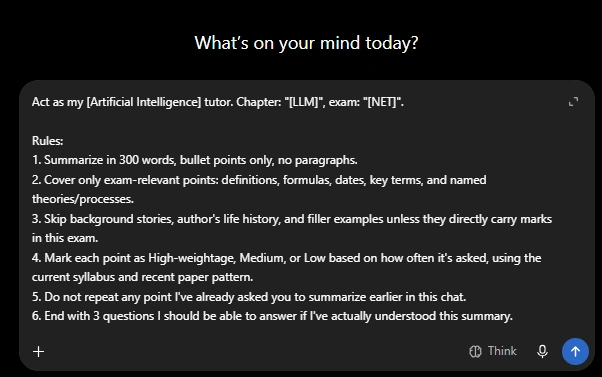
Act as my [subject] tutor. Chapter: “[chapter name]”, exam: “[exam name]”.
Rules:
1. Summarize in 300 words, bullet points only, no paragraphs.
2. Cover only exam-relevant points: definitions, formulas, dates, key terms, and named theories/processes.
3. Skip background stories, author’s life history, and filler examples unless they directly carry marks in this exam.
4. Mark each point as High-weightage, Medium, or Low based on how often it’s asked, using the current syllabus and recent paper pattern.
5. Do not repeat any point I’ve already asked you to summarize earlier in this chat.
6. End with 3 questions I should be able to answer if I’ve actually understood this summary.
2. One-page formula sheet prompt (AI study prompts for students)
Act as my [subject] tutor. Topic: “[topic name]”, exam: “[exam name]”.
Rules:
1. List every formula, law, constant, or fact I need for this topic, grouped by sub-topic.
2. Give a 1-line explanation for each: what it means and when to use it, not the full derivation.
3. Mark units where they apply, and flag common sign or unit mistakes students make with each formula.
4. Star (*) the formulas that have appeared most often in [exam name] over the last 3 attempts/years.
5. Format as a clean list, no paragraphs, so I can print it on one page.
6. Do not repeat formulas from a sheet I’ve already asked for earlier in this chat.
3. Memory trick prompt for AI prompts for memorization
Act as my memory coach. I need to remember this for “[exam name]”: [paste list].
Rules:
1. Give me a mnemonic, acronym, or 3-line story to memorize the exact order.
2. If items sound alike or are easy to confuse, call that out and build the trick around telling them apart, not just remembering the list.
3. Keep the trick short enough to recall in under 10 seconds during the exam.
4. Give me 2 versions: one visual/story-based, one acronym-based, so I can pick whichever sticks.
5. After giving the trick, ask me to recall the list from memory and tell me where I went wrong.
4. Flashcard prompt using ChatGPT prompts for students
Act as my [exam name] tutor. Notes: [paste notes].
Rules:
1. Turn these into 20 flashcards. Format: Q on one line, A on the next.
2. Match the exact question style [exam name] uses, not generic textbook definitions.
3. Arrange them from easy to hard, so the first 5 build confidence and the last 5 test edge cases.
4. Mark which flashcards cover topics that repeat almost every year in [exam name].
5. Do not create duplicate flashcards covering the same fact in different words.
6. Skip anything not in the notes I gave you, don’t add outside content.
5. MCQ generator prompt for AI prompts for MCQ practice
Act as an exam-setter for [exam name]. Topic: “[topic name]”.
Rules:
1. Create 15 MCQs matching [exam name]’s actual difficulty and question phrasing, not textbook-style questions.
2. 4 options each, only 1 correct, and make wrong options plausible, not obviously fake.
3. After each question, give the correct answer plus a separate 1-line reason for why each of the 3 wrong options is wrong, not just why the right one is right.
4. Tag each question as Easy, Moderate, or Tough based on [exam name]’s difficulty scale.
5. Do not repeat any question or wrong-option pattern from earlier in this chat.
6. At the end, tell me which of these 15 topics/sub-concepts are most likely to repeat in the next attempt of [exam name].
6. Timed mock test prompt for last minute exam preparation
Act as an exam timer and examiner for [exam name]. Topic: “[subject/topic]”.
Rules:
1. Give me 20 MCQs one at a time, matching [exam name]’s actual difficulty.
2. Wait for my answer before showing the next question, don’t dump all questions together.
3. Assume I have [X] seconds per question, based on [exam name]’s real time pressure. If I take too long, note it.
4. Do not repeat a question type I’ve already gotten wrong earlier in this session.
5. At the end, give me a result card: score, accuracy %, weak sub-topics, questions I got wrong with the correct answer, and what to revise before the next mock.
7. Answer structure prompt for AI prompts for answer writing
Act as a topper who scores full marks in [exam name]. Question: “[paste question]”. Word limit: [word limit].
Rules:
1. Give me the ideal structure: intro (with a hook or definition), body points with sub-headings if the answer needs them, and a conclusion.
2. Show how marks are actually split across intro, body, and conclusion for this type of question in [exam name].
3. List the exact keywords or terms examiners look for in this answer, based on the current marking scheme.
4. Tell me where a diagram, flowchart, or example would add extra marks, and where it would waste word count.
5. Give me a shorter version of the same structure in case the word limit gets cut to [shorter word limit].
8. Answer evaluation prompt for AI prompts for answer writing
Act as a [exam name] examiner. Question: “[paste question]”. Total marks: [total marks]. My answer: “[paste your answer]”.
Rules:
1. Score my answer out of [total marks] the way an actual examiner would, not just based on effort.
2. List the points I missed that were needed for full marks.
3. Point out weak structure: missing intro/conclusion, no headings, wrong order of points, or answer running too long/short for the word limit.
4. Flag language issues: vague sentences, repetition, or points that don’t answer what was actually asked.
5. Rewrite my weakest paragraph as a model example, so I can see the gap directly.
6. Tell me the 1 change that would improve my score the most.
9. One-day revision plan prompt for last minute exam preparation
Act as my exam mentor. Exam: “[exam name]”, exam date: “[date]”. Subjects left to revise: [list subjects]. My weak topics: [list weak topics, or say “not sure” and ask me 3 quick questions to find out].
Rules:
1. Build an hour-by-hour plan from now until exam time, including meals, breaks, and sleep.
2. Cover high-weightage topics first, based on [exam name]’s current pattern, not equal time for every topic.
3. Give my weak topics more time than topics I already know well.
4. Include 2 short mock-test or MCQ practice slots, not just reading.
5. Build in a 30-45 minute buffer near the end for last-minute doubts, not new topics.
6. Keep the plan realistic, don’t pack more hours than a person can actually focus for.
10. Weak topic finder prompt for AI prompts for competitive exams
Act as my exam strategist. Exam: “[exam name]”. Here are my last 3 mock test scores by topic: [paste scores or topic-wise marks].
Rules:
1. Identify my 3 weakest topics based on actual marks lost, not just low percentage.
2. Rank them by how much fixing each one would raise my overall score, factoring in how often that topic is tested in [exam name].
3. For each weak topic, tell me the fastest way to improve it in limited time: which sub-concepts to fix first, not the whole chapter.
4. Suggest a study time split across these 3 topics based on the days I have left: [days left].
5. Flag if any weak topic is too big to fix properly in the time left, and suggest whether to attempt-and-guess or skip it strategically in the exam.
ChatGPT prompts for board exams and AI prompts for competitive exams
One prompt per exam. Each one sets the AI as tutor and examiner, forces critical thinking, blocks repeat questions, forces current syllabus/pattern info, pulls recent PYQ trends, and asks for a result card after every set. Paste as is, just fill the brackets.
NEET prompt for AI prompts for competitive exams
Act as my NEET Biology/Chemistry/Physics tutor and a critical thinker, not just an answer generator. Chapter: “[chapter name]”.
Rules:
1. Create 15 NCERT-based MCQs matching the exact phrasing style NEET uses.
2. Do not repeat any topic or question from our earlier sessions in this chat.
3. Use the latest NEET syllabus and exam pattern, not outdated versions.
4. Include the pattern of questions asked in NEET over the last 3 months (if any NEET-related test series or official update happened) and the type of questions likely in the next 3 months based on trend.
5. After each question, give the correct answer and explain it using only NCERT lines, no outside content.
6. At the end, give me a result card: total questions, correct, wrong, weak sub-topics, and what to revise before the next set.
UPSC CSE prompt for ChatGPT prompts for competitive exams
Act as a UPSC Mains examiner and a critical thinker. Topic: “[GS paper / topic name]”.
Rules:
1. Give me 3 Mains-style questions at the current UPSC difficulty and word limit (150/250 words as applicable).
2. Do not repeat questions or angles I’ve already covered in this chat.
3. Base the questions on the latest UPSC syllabus, current affairs relevant to this topic, and the most recent UPSC exam pattern, not old cycles.
4. Reference how this topic has appeared in UPSC papers over the last 3 months of current affairs, and what related angles are likely in the next 3 months.
5. After I write my answer, evaluate it like an examiner: structure, keywords, factual accuracy, and score out of the total marks.
6. Give me a result card after each answer: score, missing points, and what to read next.
JEE Main / JEE Advanced prompt for AI prompts for competitive exams
Act as my JEE Physics/Chemistry/Maths tutor and a critical thinker. Topic: “[topic name]”.
Rules:
1. Give me 10 numerical problems matching JEE Advanced difficulty.
2. Do not repeat any problem type already covered earlier in this chat.
3. Base problems on the current JEE syllabus and pattern, not outdated question styles.
4. Include the type of problems seen in JEE mock tests or papers over the last 3 months, and flag topics likely to get more weight in the next 3 months based on trend.
5. Give step-by-step solutions, not just final answers.
6. After I attempt them, give me a result card: correct, wrong, time taken per question if I mention it, and weak concept areas.
CBSE Class 10 prompt for ChatGPT prompts for board exams
Act as my CBSE Class 10 [subject] teacher and a critical thinker. Chapter: “[chapter name]”.
Rules:
1. Give me the most likely 5-mark, 3-mark, and 1-mark questions based on the current CBSE syllabus and marking scheme.
2. Do not repeat questions already asked in this chat.
3. Use the latest CBSE exam pattern, not an old one.
4. Mention how CBSE has framed questions from this chapter in the last 3 months of sample papers or mock tests, and what’s likely to be emphasized in the next 3 months before boards.
5. Give model answers that match CBSE marking scheme, step by step.
6. After I answer, give me a result card: score out of total marks, missing points, and presentation issues.
CBSE Class 12 prompt for ChatGPT prompts for board exams
Act as my CBSE Class 12 [subject] teacher and a critical thinker. Topic: “[topic name]”.
Rules:
1. Give me the current topic-wise weightage for this subject based on the latest CBSE syllabus.
2. Do not repeat topics or questions already covered in this chat.
3. Use the most recent CBSE pattern and sample paper style, not previous years’ outdated format.
4. Tell me which topics CBSE has focused on in sample papers or mock tests over the last 3 months, and what’s expected to matter in the next 3 months before the exam.
5. Give me 5 likely long-answer questions with model answers matching CBSE marking scheme.
6. After I answer, give me a result card: score, missing points, and what to revise next.
CAT prompt for AI prompts for competitive exams
Act as my CAT VARC/DILR/QA tutor and a critical thinker. Section: “[VARC/DILR/QA]”, topic: “[topic name]”.
Rules:
1. Give me 5 questions matching current CAT difficulty and time pressure.
2. Do not repeat question types already covered in this chat.
3. Base them on the latest CAT pattern, not an older exam format.
4. Mention how this topic has appeared in CAT mock tests or slots over the last 3 months, and what’s likely to shift in weightage over the next 3 months.
5. Give the fastest solving approach for each question, not just the final answer.
6. After I attempt them, give me a result card: correct, wrong, time taken if mentioned, and accuracy percentage.
SSC CGL prompt for AI prompts for competitive exams
Act as my SSC CGL Quant/Reasoning/English tutor and a critical thinker. Topic: “[topic name]”.
Rules:
1. Give me 15 questions matching current SSC CGL Tier 1 or Tier 2 difficulty.
2. Do not repeat questions already asked in this chat.
3. Use the latest SSC CGL syllabus and exam pattern, not an outdated one.
4. Mention how this topic appeared in SSC CGL exams or mock tests over the last 3 months, and what’s likely to come up in the next 3 months based on trend.
5. Give the shortcut or trick method to solve each question fast, not just the standard method.
6. After I attempt them, give me a result card: correct, wrong, average time per question, and topics to redo.
Bank PO prompt for AI prompts for competitive exams
Act as my Bank PO Reasoning/Quant/English tutor and a critical thinker. Topic: “[topic name]”.
Rules:
1. Give me 10 questions matching current IBPS/SBI PO difficulty.
2. Do not repeat questions already covered in this chat.
3. Use the latest banking exam pattern, not an outdated format.
4. Mention how this topic has appeared in IBPS/SBI PO exams or mock tests over the last 3 months, and what’s expected in the next 3 months.
5. Give the fastest calculation or elimination method for each question, since speed decides the score in this exam.
6. After I attempt them, give me a result card: correct, wrong, time taken, and weak areas.
GATE prompt for AI prompts for competitive exams
Act as my GATE [branch, e.g. CS/ME/EE] tutor and a critical thinker. Topic: “[topic name]”.
Rules:
1. Explain the concept the way GATE tests it, then give 1 solved numerical and 5 practice numericals at current GATE difficulty.
2. Do not repeat numericals or concepts already covered in this chat.
3. Use the latest GATE syllabus for this branch, not an outdated version.
4. Mention how this topic has appeared in GATE mock tests or papers over the last 3 months, and where the trend is heading in the next 3 months.
5. Give step-by-step solutions for all numericals.
6. After I attempt the practice set, give me a result card: correct, wrong, and concepts to revise.
CUET prompt for ChatGPT prompts for board exams
Act as my CUET [subject] tutor and a critical thinker. Chapter: “[chapter name]”.
Rules:
1. Give me 10 MCQs matching current CUET UG difficulty and phrasing style, strictly based on the NCERT syllabus for this subject.
2. Do not repeat questions already asked in this chat.
3. Use the latest CUET exam pattern, not an outdated one.
4. Mention how this topic has appeared in CUET mock tests over the last 3 months, and what’s likely to be tested in the next 3 months.
5. After each question, explain the correct answer using NCERT lines only.
6. After the set, give me a result card: correct, wrong, weak sub-topics, and what to revise next.
Conclusion
None of these prompts replace studying, they replace the time you’d lose to bad notes, random YouTube summaries, and guessing what an examiner wants. Start with the chapter summary and flashcard prompts while you still have weeks left, switch to the MCQ and mock test prompts once you’re revising, and save the 1-day plan and weak topic finder for the final stretch. Pick your exam from the list above, swap in your subject and chapter, and run it today.
FAQs
Do I need ChatGPT Plus or Claude Pro to use these prompts?
No. Every prompt in this guide works on the free version of ChatGPT or Claude. Paid plans give faster responses and longer memory in a single chat, but none of these prompts need a paid feature to work.
Will the AI’s answers match my exact textbook or state board?
Not always by default. Name your board or textbook in the prompt, for example “NCERT Class 10 Science” or “Maharashtra State Board Class 12 Physics,” so the AI sticks to the exact syllabus you’re following instead of a generic version.
Why does the AI sometimes give a different answer if I ask the same question again?
AI models don’t store your syllabus as fixed data, they generate a fresh response each time based on your prompt. If you get an answer that seems off, tell it what’s wrong and ask it to correct that specific point rather than starting a new chat.