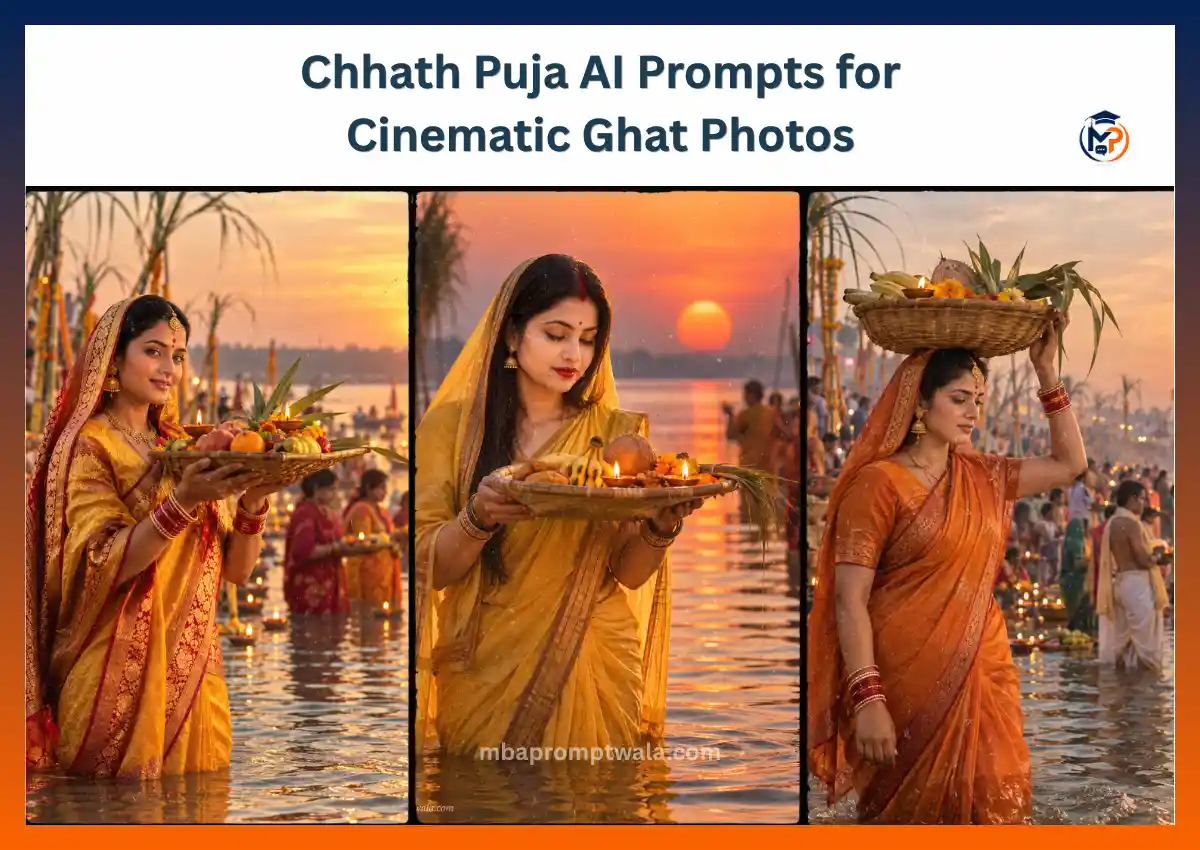
Hi, I’m Keshav Chouhan. I test ChatGPT and Gemini photo prompts every week, especially prompts where the uploaded person’s face needs to stay recognizable.
Chhath Puja is one of the harder festivals to recreate with AI images.
The problem is not simply adding a river, diya, saree and sunset.
When I started working on these prompts, I noticed that the image quickly looked artificial if I left the lighting direction unclear. The sun might appear behind the person while the face was lit from the wrong side. Water reflections could go in another direction, and the diya glow sometimes looked pasted onto the scene.
So for this collection, I paid more attention to where the sun is, how its light reaches the subject, what the water reflects, what the person is doing, and how the camera sees the scene.
Chhath Puja 2026 runs from Friday, 13 November to Monday, 16 November. Sandhya Arghya falls on Sunday, 15 November, followed by Usha Arghya on Monday morning.
The prompts below cover more than the usual sunset portrait. I have included crowded ghat photography, Usha Arghya, Nahay Khay, a studio interpretation, night flash photography, a handmade diorama and different portrait compositions.
If you want to use your own face, upload a clear reference photo before pasting the prompt.
What I Focused on While Creating These Chhath Puja Prompts
I did not want all 11 images to look like the same AI portrait with a different saree.
I changed the camera position, focal length, time of day, environment and type of light between concepts.
There are a few details I deliberately repeat inside the prompts.
Face preservation: When a reference photo is being used, I explicitly tell the model not to reshape or beautify the face.
Light direction: Chhath photography depends heavily on sunrise and sunset, so I describe where the sun sits instead of simply asking for “golden hour.”
Water behavior: I mention reflections, ripples, wet fabric or reflected sunlight where relevant. Otherwise, AI-generated river water can become a smooth blue background with very little physical connection to the scene.
Camera choice: I use different lenses depending on the image. A long lens works for a compressed sunset portrait, while a wider lens makes more sense when I want the ghat and crowd to become part of the story.
Clothing and ritual details: I try to describe the clothing, soop, daura, diya, fruit and other visible elements instead of leaving the model to invent everything.
You do not need to understand camera settings to use these prompts. They are there to give the image model a clearer visual direction.
Chhath Puja Sunset AI Photo Prompt
This is the most detailed prompt in the collection.
I wanted the result to feel closer to a photograph taken by someone standing at the ghat than a polished festival poster.
The difficult part was balancing three sources of visual interest, the woman, the sunset and the offerings. If all three are made equally bright and sharp, the image starts feeling constructed.
So the prompt keeps the woman and offering basket as the focus while allowing the devotees, boats and decorations to fall softly into the background.
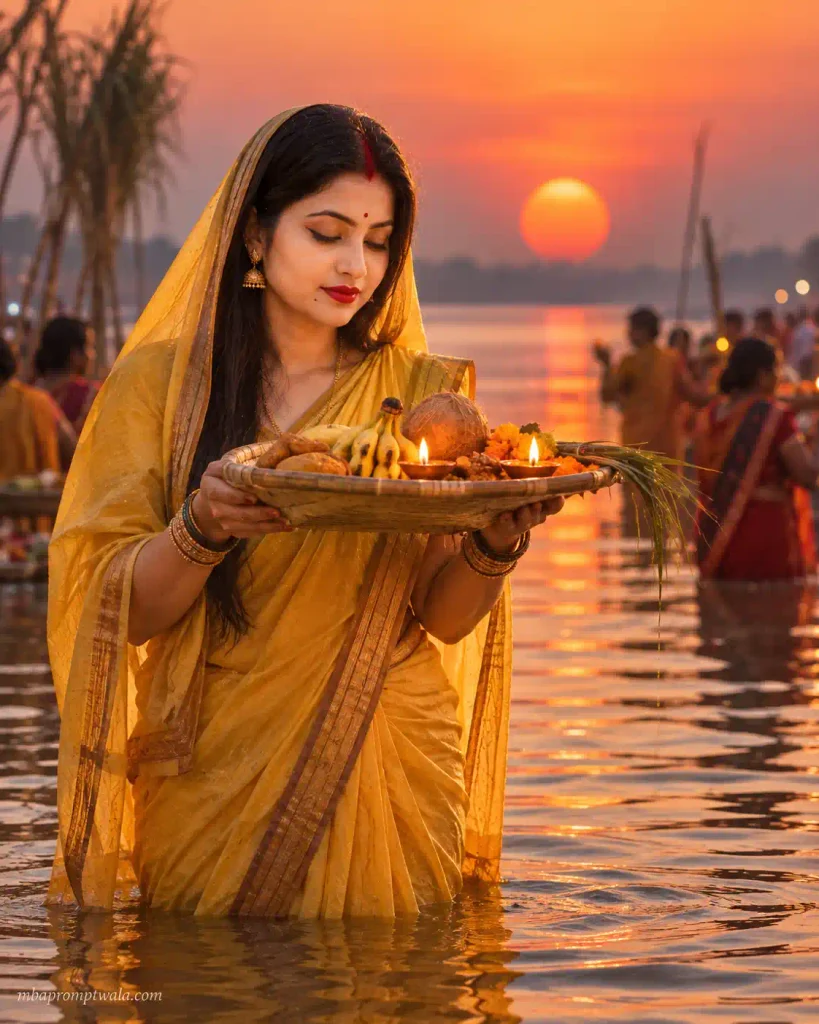
Use the uploaded reference image as the primary identity reference for the woman. Preserve her identity naturally and consistently: same facial structure, face proportions, eyes, eyebrows, nose, lips, jawline, natural skin tone, hairline and visible natural marks. Do not alter, reshape, whiten, beautify or excessively smooth the face. Preserve realistic pores, fine lines and natural skin texture.
Create a highly photorealistic documentary-style photograph of the same adult woman performing Sandhya Arghya during Chhath Puja at a busy Indian river ghat during golden-hour sunset.
COMPOSITION:
Full-to-three-quarter body portrait, woman standing waist-deep in calm shallow river water, positioned slightly left of centre. She holds a traditional bamboo daura/soop at chest height with both hands. The basket contains realistic Chhath offerings: thekua, bananas, apples, a coconut, seasonal fruits, sugarcane leaves and two small lit diyas. Keep the offerings naturally arranged, physically believable and proportionally correct.
POSE AND EXPRESSION:
Natural devotional posture, shoulders relaxed, head slightly bowed, eyes gently closed, peaceful expression. Her body should have realistic human proportions and anatomy. Hands, fingers, arms, legs and feet must be anatomically correct and naturally positioned.
CLOTHING:
Traditional deep maroon-red Banarasi-style saree with a subtle gold woven border and realistic fabric texture. Pallu draped naturally over the head and shoulder. Traditional Indian gold jewellery including jhumka earrings, necklace, bangles and a subtle maang tikka. Keep jewellery elegant rather than excessive.
ENVIRONMENT:
A real Indian riverside ghat during Chhath Puja. Wet stone steps filled with softly blurred devotees performing prayers. Numerous small diyas placed along the steps and floating naturally on the water. Traditional bamboo decorations, sugarcane arches and marigold garlands around the ghat. A few distant boats on the river. Gentle incense smoke drifting through the scene. Background people should remain softly out of focus and should not compete with the main subject.
LIGHTING:
Low golden-orange setting sun behind the woman, creating a natural rim light around her shoulders, veil and basket. Warm reflected sunlight and diya glow should bounce naturally onto her face, hands and saree. Preserve realistic exposure and dynamic range. No artificial beauty lighting.
PHOTOGRAPHY:
Professional full-frame camera look, Canon EOS R5, 70–200mm lens at approximately 135mm, f/2.8. Shallow depth of field, realistic optical compression, natural bokeh, accurate perspective, crisp focus on the woman’s face and offering basket, softly blurred background.
REALISM:
Photorealistic Indian documentary photography. Natural skin pores, fine facial texture, individual hair strands, realistic wet fabric, authentic water reflections, physically accurate shadows and reflections. No plastic skin, no CGI appearance, no excessive HDR, no over-sharpening, no fantasy glow.
COLOUR:
Warm golden sunset highlights, subtle neutral skin tones, slightly cooler shadows, rich but realistic maroon and gold clothing, natural blue-grey water. Cinematic but restrained colour grading.
IMPORTANT:
Do not add any text, captions, social-media interface elements, icons, arrows, logos or decorative graphics anywhere in the image.
Aspect ratio: 4:5.
Add only a small “mbapromptwala.com” watermark in the bottom-left corner, thin elegant white lettering, low opacity and unobtrusive.
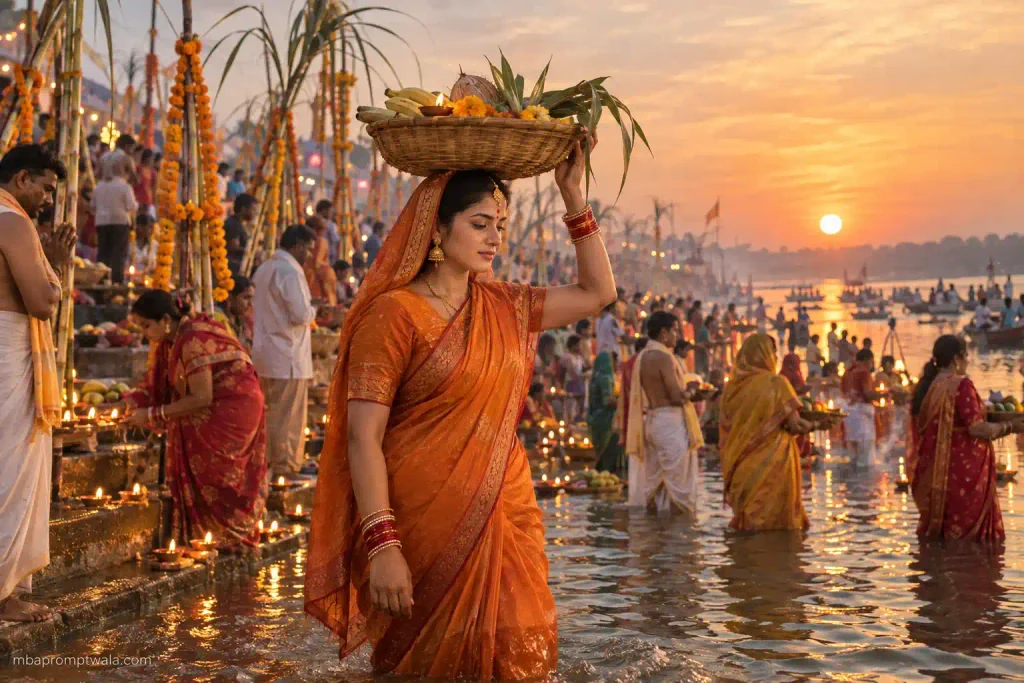
Chhath puja prompt for the Sandhya Arghya frame
The sun sits behind the subject and the river bounces light back onto her face. A long lens flattens the sun into a big soft disc.
Prompt
Keep the face from the uploaded reference completely unchanged: same bone structure, eye shape, brows, lip line, skin tone and natural skin marks. The same woman stands knee-deep in river water at sunset during Sandhya Arghya, holding a bamboo soop at chest height loaded with thekua, bananas, a coconut and two lit diyas. Plain yellow handloom cotton saree, pallu drawn over the head, long sindoor from the nose bridge into the hairline, bare feet. The setting sun sits low directly behind her, going red, rimming her shoulders and the soop edge. Water throws orange bounce onto her face. Eyes closed, head bowed. Shot on Canon EOS R5, 70-200mm f/2.8 at 200mm, sun rendered as a large soft disc. Real skin texture, no smoothing. Aspect ratio 4:5. Place mbapromptwala.com as a thin white semi-transparent watermark bottom-left.
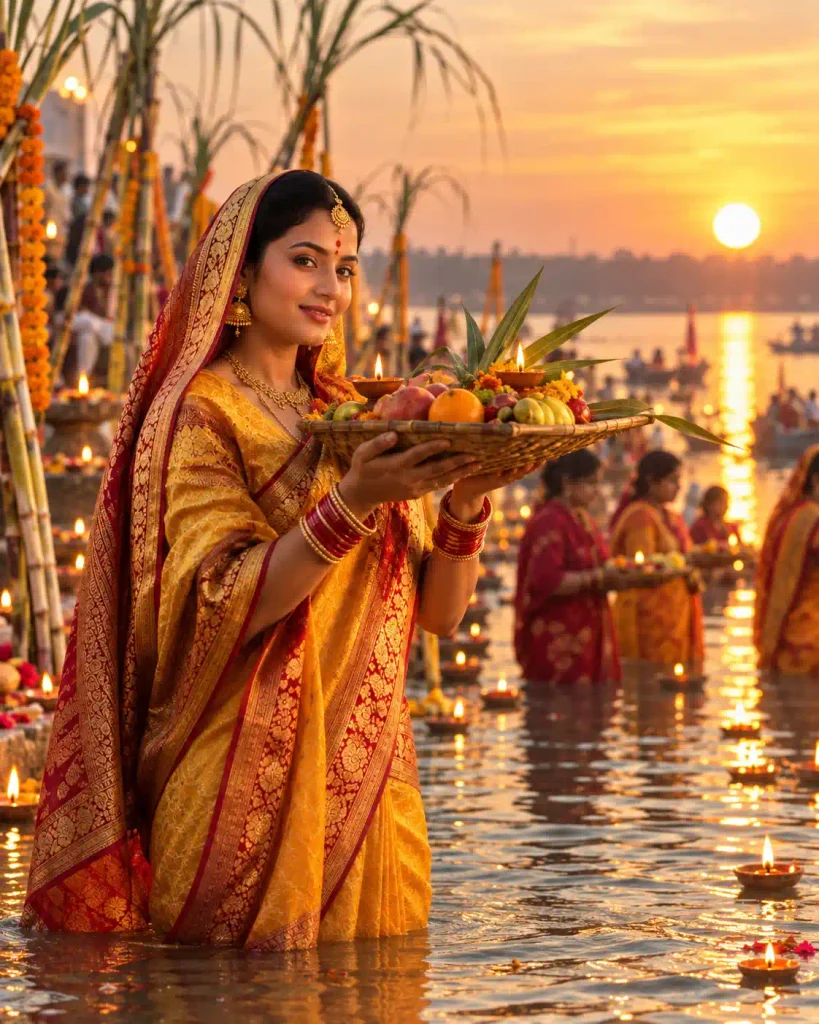
Chhath puja realistic photo prompt at a crowded ghat
Wide lens, waist height, nobody looking at the camera. The diyas and sugarcane arch behind do the work here.
Prompt
Carry the uploaded person’s identity across exactly, with no change to features, proportions or complexion. Documentary frame of the same person at a packed river ghat in the last light, walking through shallow water with a daura balanced on the head. Other families lighting diyas along the wet steps, a marigold-tied sugarcane arch behind, smoke drifting low. Plain orange cotton saree, damp at the hem. Mid-stride, not looking at the camera. Shot on Nikon Z8, 24mm f/1.8 from waist height. Kodak Gold 200 colour response, warm highlights, haze, fine grain, minor barrel distortion left in. Nothing retouched. Aspect ratio 3:2 horizontal. Sign it with mbapromptwala.com in thin white type at the bottom-left.
Chhath Puja Studio Portrait Prompt
I added this because I did not want every idea in the article to depend on a river and sunset.
The setup is intentionally simple, a dark backdrop, one main light and a soop.
The light behind the subject stands in for the setting sun, while the front bounce keeps the face visible.
This gives you a Chhath-inspired portrait that feels very different from the usual ghat image.
Prompt
Reproduce the uploaded face with no alteration to any feature or tone. Studio portrait, waist up, on a deep charcoal painted backdrop. The same person holds a bamboo soop with thekua, sugarcane and a single diya, hands lifted so the flame sits below the chin. Plain red-bordered cream cotton saree, pallu over the head, only thin gold bangles. One hard fresnel low and behind acts as the setting sun, rimming the soop and shoulder line. A white bounce card off frame fills the face softly. Shot on Fujifilm GFX 100 II, 55mm f/1.7. Deep blacks, restrained contrast, visible skin texture, gallery print quality. Aspect ratio 4:5. Small mbapromptwala.com watermark bottom-left, thin white lettering.
Chhath Puja Poster Prompt
This one is designed differently because a poster needs room for text.
A mistake I often see in AI poster prompts is asking for a beautiful full-frame portrait first and then trying to squeeze the festival greeting into whatever space remains.
Here, the composition creates the text space from the beginning.
The person sits lower in the frame while the upper area carries the sun and greeting.
Prompt
Use the uploaded photo as the identity source and hold the face exactly as it is. Vertical poster composition: the same person lower-centre in shallow water, seen from a low angle just above the surface, arms raised holding a soop towards a huge setting sun filling the upper frame. Plain saffron cotton saree, wet at the hem, bare feet, water rings spreading outward. Strong lens flare, silhouette edges glowing, water broken into orange highlights. Shot on Sony A1, 35mm f/1.4. Warm amber against deep teal shadows, heavy contrast, cinematic poster finish. Leave the top third clean for typography and set the words Happy Chhath Puja there in gold serif lettering. Aspect ratio 9:16. Bottom-left carries mbapromptwala.com in thin white text.
Chhath Puja Night Flash Photo Prompt
I wanted one image that did not use the polished golden-hour look at all.
This prompt moves to the ghat after the evening offering.
Direct flash gives it harder highlights, deeper darkness and a more spontaneous handheld-photo feeling. The rows of diyas remain visible behind the subject, but the flash becomes the main source lighting the person.
Prompt
Keep the uploaded person’s face untouched: identical features, identical skin tone, identical expression. Night frame on the stone steps of a ghat after the evening offering, the same person crouched low, cupping a lit clay diya in both hands. Rows of diyas stretch into the dark behind, going to bokeh. Plain magenta cotton saree, bare feet on wet stone. Direct on-camera flash fired straight at them, blowing out the nearest highlights and dropping the background to near black. Diya smoke catches the flash in the air. Shot on Fujifilm X100VI, fixed 23mm, slightly tilted handheld frame. Punchy contrast, cool white balance, mild vignette. Aspect ratio 4:5. Finish with mbapromptwala.com in small thin white lettering bottom-left.
Chhath Puja 3D Handmade Diorama Prompt
This is deliberately not photorealistic.
I wanted to see whether the same festival scene could work as something that looks physically handmade instead of another 3D render with perfectly smooth surfaces.
That is why the prompt asks for thumbprints in the clay, stitched felt, thread, painted card and matchstick details.
Those imperfections are part of the look.
Prompt
Preserve the uploaded face as the likeness reference so the figure stays recognisable. Handmade stop-motion diorama of the same person as a 12 cm clay figurine, ankle-deep in a shallow tray of real water standing in for the river, holding a woven soop with tiny clay thekua and a grain-of-rice diya. Visible thumbprints in the clay, felt saree with stitched edges, thread garland, painted card ghat steps with matchstick sugarcane. Warm orange key low behind as the sun, soft blue fill in front. Shot macro on a Nikon Z9 with a 105mm macro lens, shallow focus across the figurine’s face. Practical set look, dust kept in, no CGI polish. Aspect ratio 1:1. Add mbapromptwala.com bottom-left in thin white type.
Usha Arghya Sunrise Photo Prompt
The sunrise frame should not simply look like the sunset prompt flipped around.
For Usha Arghya, I wanted a colder and quieter morning atmosphere.
The mist, pale sun, lower contrast and restrained colours help separate this image from the warmer Sandhya Arghya scenes earlier in the article.
Prompt
Retain the uploaded reference face without modifying any feature, line or tone. Early morning Usha Arghya frame, the same person waist-deep in still water facing a pale sun just clearing the far bank, offering water from a small brass lota with both hands. Cold mist on the surface, breath faintly visible, plain white saree with a red border, pallu over the head. Family waiting on the steps behind, out of focus. Light soft and cool overall, one thin warm shaft on the face and falling water. Shot on Leica SL3, 90mm f/2. Muted pale blue, white and weak gold, low contrast, gentle highlight roll-off. Aspect ratio 3:4. Mark it with mbapromptwala.com in thin white lettering, bottom-left.
Nahay Khay Kitchen Photo Prompt
Chhath is not visually limited to the riverbank.
For this prompt, I moved indoors.
This is intentionally a quieter frame, with window light, flour on the hands, a wooden board and a mud chulha.
Instead of a large ceremonial scene, the image gets its detail from ordinary physical textures, flour, fabric, metal, firelight and the darker corners of the room.
Prompt
Hold the uploaded face identical to the reference, including features, skin tone and hairline. Indoor Nahay Khay frame: the same person sitting on a traditional kitchen floor shaping thekua dough by hand on a wooden board, wheat flour on the fingers and forearms. A mud chulha burns low beside her with a brass kadhai of ghee, kaddu-bhaat in a steel thali. Plain green cotton saree, hair tied up, one loose strand. A hard shaft of late morning sun through a small window lights the flour dust, room corners dark. Shot on Panasonic S5 II, 50mm f/1.8. Warm neutral grade, deep shadows, documentary feel. Aspect ratio 5:4. Bottom-left: mbapromptwala.com in fine white lettering.
Chhath Puja Photo Prompt for Girls
This is a tighter portrait than the crowded ghat version.
The main visual trick is the backlight passing around the pallu and loose hair. A longer 105mm lens also removes much of the surrounding clutter and turns the water behind the subject into softer bands of warm colour.
Prompt
The uploaded girl’s face must stay exactly as given, with no change to features, jawline, complexion or expression. She stands in still water at the end of the day, turned three-quarters to the lens, holding a loaded bamboo soop against her chest. Plain orange handloom saree with a thin red border, pallu over the head, long sindoor from the nose bridge to the hairline, small gold nath, thin bangles, kajal only. Calm expression looking just past the camera. The low sun sits behind her left shoulder, burning a bright rim along the pallu edge and loose hair. Water behind compressed into orange bands. Shot on Nikon Z8, 105mm f/1.4, background heavily blurred. True skin texture, warm grade. Aspect ratio 3:4. Add mbapromptwala.com as a thin white watermark bottom-left.
Chhath Puja Photo Prompt for Boys
For the final prompt, I wanted movement rather than another person standing still with an offering.
The subject is walking into the river with the daura on his shoulder.
The low sun creates a rim on the body while the movement of his feet gives the water something physical to react to.
Prompt
Keep the uploaded boy’s face unchanged from the reference: same features, same skin tone, same hair. He walks into the river at sunset with a heavy bamboo daura on his right shoulder, loaded with sugarcane, coconut and covered prasad. Plain white dhoti, red gamchha across one shoulder, barefoot, water at mid-calf splashing with each step. Tilak on the forehead, eyes ahead. Crowd and diya-lit steps behind, out of focus. Sun very low and slightly to camera right, throwing a hard rim down one arm and a long shadow back across the water. Shot on Sony A7 IV, 50mm f/1.2. Warm highlights, cool shadows in the water, real wet skin detail. Aspect ratio 4:5. Add mbapromptwala.com as a thin white watermark bottom-left.
How I Use These Chhath Puja AI Prompts
My basic workflow is simple.
First, I choose one clear reference photo. I prefer a sharp image where the face is visible from the front and is not covered by sunglasses, hair or a strong filter.
Then I:
- Open ChatGPT or Gemini.
- Upload the reference image.
- Paste one prompt without changing it on the first attempt.
- Generate the image.
- Look at the face, hands, ritual objects, clothing, water and lighting separately.
- Correct only the part that actually failed.
That last step matters.
If the face is good but the water is wrong, I do not rewrite the outfit, camera, pose and lighting at the same time.
I correct the water.
Changing five things after every generation makes it difficult to know which instruction actually improved the result.
What I Check Before Keeping an AI-Generated Chhath Photo
A beautiful image can still have obvious AI mistakes.
These are the areas I check first.
Face
If I uploaded a reference photo, does the result still look like the same person?
I look at the eye shape, jaw, nose, skin tone and overall face proportions rather than only asking whether the image is attractive.
Hands and Offering Basket
The soop contains several objects close together, which gives an image model plenty of opportunities to merge fingers, fruit, diya flames and basket edges.
Zoom in before keeping the result.
Light Direction
If the sun is behind the person, I expect some rim light or backlight.
The face may receive softer reflected light from the water, but it should not look as though a large studio light is coming from the opposite direction unless the prompt intentionally creates that setup.
Water
This is one of the first places I notice an artificial result.
Look for reflections, ripples around the body, wet fabric and the way light interacts with the surface.
Background People
A blurred crowd does not need perfect portrait-level faces, but obviously duplicated bodies, floating people or broken limbs can ruin an otherwise convincing image.
Tips for Getting Cleaner Results
These are the adjustments I make when a first generation does not work.
Put the Identity Instruction Near the Beginning
When face consistency matters, I state it immediately instead of hiding it near the end of a long prompt.
I also describe what should stay consistent, such as facial structure, skin tone, hairline and visible natural features.
Describe the Sun Instead of Asking for “Cinematic Lighting”
“Cinematic” can mean almost anything.
For these images, I get more predictable compositions when I describe where the sun sits and what it should light.
For example:
Low sun behind the left shoulder, creating rim light along the pallu.
That gives the model a more concrete visual instruction.
Tell the Model What the Water Is Doing
Instead of simply writing “river,” I describe something visible:
Orange reflection bands.
Ripples spreading from the feet.
Still water with pale morning mist.
Wet fabric at the hem.
In my tests, those details make the water feel more connected to the subject.
Do Not Overload Every Scene
I do not need sugarcane arches, hundreds of diyas, boats, flowers, smoke, crowds, temples and fireworks in every frame.
More festival objects do not automatically create a better festival photograph.
Sometimes the quieter image looks more believable.
Change One Major Thing at a Time
If the first result is close, I avoid completely rewriting the prompt.
For example:
Keep everything unchanged. Correct only the hands and preserve the same face, clothing, composition and lighting.
This makes it easier for me to judge whether the correction actually worked.
ChatGPT vs Gemini for Chhath Puja AI Photos
I would not call one model the winner for every image.
In my own prompt testing, I have found that Gemini can sometimes hold the uploaded face more consistently, while ChatGPT can be stronger at following detailed camera, composition and lighting instructions.
That is an observation from my testing, not a guarantee.
Results can change with the reference image, prompt, model version and even another generation using the same instructions.
If you already use both, I recommend trying the same prompt and same reference photo in each model.
That comparison is more useful than changing the prompt for one model and then trying to decide which model performed better.
Why Your Chhath Puja AI Photo May Still Look Fake
Even a detailed prompt cannot guarantee a perfect generation.
If the result looks artificial, I would diagnose the problem before adding more descriptive words.
The Face Changed
Use a clearer reference image and repeat only the identity requirement.
Do not simultaneously request a new pose, hairstyle and expression if face consistency is already failing.
The Water Looks Like a Blue Sheet
Add physical behavior.
Mention ripples, reflected sunlight, wet cloth, surface mist or water movement around the body.
The Sunset Looks Pasted Into the Background
Describe how the sunset affects other objects.
If the sun is behind the person, mention the rim light it creates and the reflection it produces on the water.
The Image Looks Too Perfect
Reduce beauty-oriented language.
Ask for real skin texture, restrained colour grading, natural exposure, ordinary fabric texture and small photographic imperfections where they suit the concept.
The Scene Is Too Busy
Remove objects.
A simple subject, soop, water and sun can sometimes communicate Chhath more clearly than a background packed with decorations.
A Note About Reference Photos
If you are creating these images with your own photo, use a clear image that you have the right to use.
For another person, especially a private individual, I recommend getting their permission before using their photo for AI editing.
Also remember that AI-generated festival images are creative images. They should not be presented as documentary photographs of a real event that actually happened if they were generated by AI.
Also Read
11 Ganesh Chaturthi AI Photo Prompts That Look Real
Frequently Asked Questions
Why does the water look fake in my results?
In my tests, simply asking for a river often gives a flat or overly clean surface.
I get better results when I describe what is physically happening to the water, such as ripple rings around the feet, reflected bands of sunlight, mist on the surface, or wet fabric touching the water.
Should I use ChatGPT or Gemini for these prompts?
I use both.
In my testing, Gemini sometimes keeps the reference face more consistently, while ChatGPT can follow detailed camera and lighting instructions more closely.
That can change between models and generations, so try the same reference image and prompt in both if you have access.
Can I use these prompts for a family photo?
Yes, but multiple faces make identity consistency harder.
Use one clear reference image where each person’s face is visible and tell the model that each individual’s identity should remain unchanged.
I would start with two or three people rather than a large group if face accuracy is important.
Why does my face change after I ask for corrections?
This often happens when too many parts of the image are changed in one follow-up.
If the first image has a good face, tell the model to preserve the existing face, pose and identity and correct only the problem you noticed.
Do I need to keep the camera and lens names?
No.
You can remove them if you want a simpler prompt.
I include them because they help communicate the type of framing, depth of field and perspective I am trying to create. They do not guarantee that the generated image will perfectly reproduce the physical behavior of that exact camera and lens.
Can I change the saree colour or aspect ratio?
Yes.
Those are easy parts to customize. I recommend generating the original version first, then changing one element at a time so you can see what effect each change has.
Final Thoughts
The biggest improvement I found while working on Chhath Puja AI prompts was surprisingly simple.
I stopped treating “cinematic” as an instruction by itself.
Instead, I described what I actually wanted the camera to see.
Where is the sun?
Where does its light fall?
What is reflected in the water?
Is the subject posing or caught mid-action?
How much of the ghat should remain visible?
Should the background feel busy or quiet?
Once those decisions are written into the prompt, the model has less visual guesswork to do.
Start with whichever prompt is closest to the photograph you want. Generate it once without rewriting everything, inspect what failed, then correct that specific problem.
That is the same process I use when testing prompts for MBA Prompt Wala, and it is far more useful than making a prompt longer simply for the sake of making it longer.