
A lot of people think AI works best with short prompts. They’ll type something like “Write my weekly plan” or “Help me save money” and hope for a great answer.
Sometimes it works.
Most of the time, it doesn’t.
The AI isn’t confused because it’s unintelligent. It’s confused because it doesn’t understand enough about your goal.
After testing hundreds of prompts across different AI models, I noticed one clear pattern. The best results didn’t come from clever tricks or secret keywords. They came from giving AI enough context to think before it started writing.
That’s why detailed 400 word AI prompts have become so popular. Instead of telling AI only what to do, they explain who you are, what the final result should look like, what to avoid, how to organize the answer, and how to improve it if information is missing.
Think of it like hiring a new employee.
If you say,
“Manage my finances.”
You’ll probably get average work.
But if you explain your income, expenses, goals, priorities, preferred budget style, and how you want reports presented, you’ll receive advice that’s far more useful.
AI works the same way.
In this guide, I’ll share three detailed 400-word prompts that I personally designed for everyday productivity. Each one focuses on solving a real problem instead of producing generic answers. More importantly, I’ll explain why each prompt works, how to customize it, and how to improve it so you can create your own high-quality prompts in the future instead of relying on copy-and-paste forever.
Why Most AI Prompts Fail (Even If They Look Good)
If you’ve ever searched for AI prompts online, you’ve probably seen examples like these:
“Create a time management plan.”
“Help me save money.”
“Reduce my stress.”
At first glance, they seem fine. They’re short, clear, and easy to type.
But there’s one problem.
They don’t give the AI enough information to produce a truly helpful answer.
Imagine asking a personal trainer to “make me fit.” They’d immediately have questions. How old are you? Do you want to lose weight or build muscle? How many days can you exercise? Do you have any injuries?
Without those details, any advice they give will be generic.
AI works exactly the same way.
When your prompt is too short, the AI has to guess what you actually want. Sometimes the guess is good. Often, it isn’t.
That’s why many people think AI gives repetitive or boring answers. The real problem usually isn’t the AI—it’s the instructions.
The Difference Between a Weak Prompt and a Strong Prompt
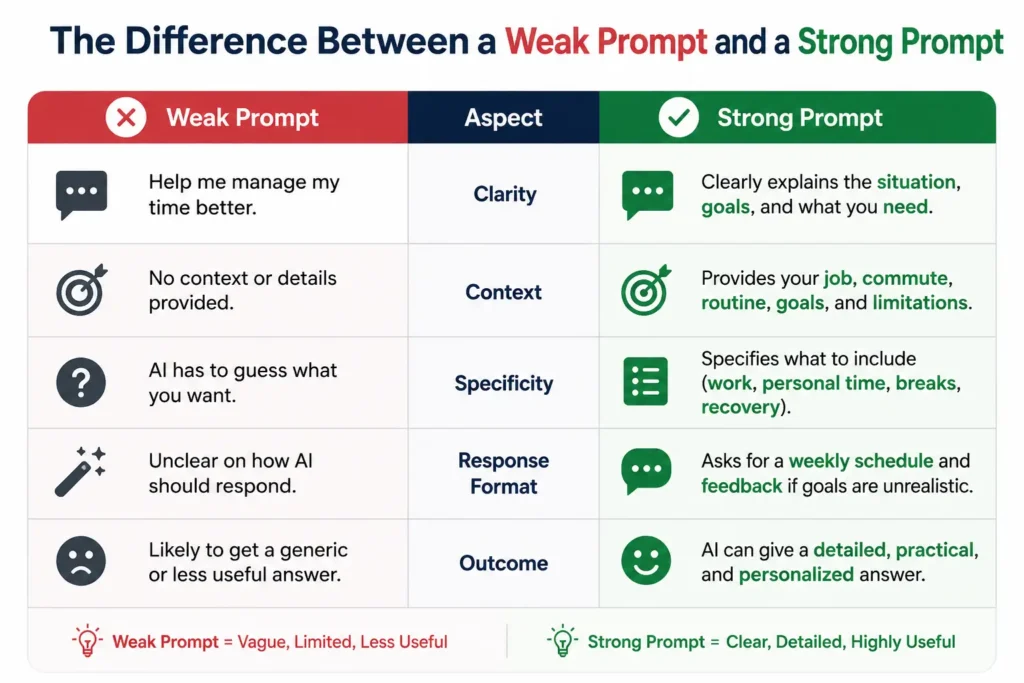
Here’s a simple example.
Weak Prompt
Help me manage my time better.
This gives AI almost no context.
Now compare it with this:
Strong Prompt
I work a full-time job from 9 AM to 6 PM and spend about two hours commuting each day. I want to exercise four times a week, study for one hour every evening, and reduce time spent scrolling on social media. Create a realistic weekly schedule that includes work, personal time, breaks, and recovery. If any goal seems unrealistic, explain why and suggest a better alternative.
Notice the difference?
The second prompt explains:
- Your current situation
- Your goals
- Your daily routine
- Your limitations
- The format you expect
- How AI should respond if something doesn’t make sense
Because the AI has more context, it can create a much more useful answer.
Why 400-Word Prompts Work Better
A longer prompt doesn’t automatically mean a better prompt.
What matters is useful information, not extra words.
A well-written 400-word prompt tells the AI things like:
- Who you are
- What you’re trying to achieve
- Your current situation
- Any limitations or challenges
- The style of response you prefer
- The format you want
- Things the AI should avoid
- What to do if information is missing
Instead of acting like a simple chatbot, the AI starts responding more like a coach, consultant, or advisor because it has enough context to think before answering.
That’s the biggest difference between an average prompt and one that consistently produces high-quality results.
The Anatomy of a High-Quality 400-Word AI Prompt
One thing I discovered while testing hundreds of AI prompts is that better results don’t come from using fancy words. They come from giving AI clear instructions in the right order.
Many people think professional prompts contain secret keywords or hidden tricks. They don’t.
Most high-quality prompts follow the same basic structure. Once you understand that structure, you can write your own prompts for almost any task.
Below are the seven building blocks I use when creating detailed AI prompts.
1. Give AI a Clear Role
The first few words tell AI how it should think before answering.
Instead of saying:
“Help me manage my money.”
Try something like:
“Act as an experienced financial coach.”
Or:
“Act as a productivity consultant.”
Giving AI a role creates more focused and relevant answers because it understands the perspective you expect.
2. Explain Your Situation
AI doesn’t know who you are unless you tell it.
Include important details such as:
- Your daily routine
- Your current challenges
- Your goals
- Your available time
- Your experience level
- Any limitations
The more useful context you provide, the less AI has to guess.
3. Describe the Final Goal
Don’t only explain the problem.
Also explain what success looks like.
For example:
- Build a realistic weekly schedule.
- Create a monthly savings plan.
- Reduce daily stress.
- Improve work-life balance.
When AI understands the destination, it can create a better path to reach it.
4. Tell AI Exactly How to Respond
This is one of the biggest mistakes people make.
Never assume AI knows your preferred format.
Instead, tell it exactly what you want.
Examples include:
- Use headings.
- Create bullet points.
- Write in simple English.
- Include examples.
- Give step-by-step instructions.
- End with an action plan.
A few formatting instructions can dramatically improve the readability of the final answer.
5. Set Clear Rules
Good prompts don’t only explain what to do.
They also explain what not to do.
For example:
- Don’t use technical jargon.
- Don’t make assumptions.
- Don’t invent information.
- Explain difficult ideas using simple language.
- If something is unclear, ask questions instead of guessing.
These rules reduce mistakes and make AI responses more trustworthy.
6. Ask AI to Think Before Answering
One trick that consistently improves output is asking AI to analyze the situation before jumping to conclusions.
Instead of giving immediate advice, ask it to:
- Review the information.
- Identify the biggest problems.
- Explain why they matter.
- Then suggest solutions in order of priority.
This usually produces much more thoughtful responses.
7. Allow Room for Improvement
A great prompt doesn’t stop after the first answer.
Ask AI to review its own work before finishing.
For example:
- Check if anything important is missing.
- Suggest improvements.
- Recommend better alternatives if needed.
- Highlight any unrealistic goals.
- Mention areas that need more information.
This extra review often turns a good response into an excellent one.
A Simple Formula You Can Reuse
Most effective long prompts follow this structure:
Role → Context → Goal → Instructions → Rules → Output Format → Self-Review
Once you learn this formula, you won’t need to search for prompts every time. You’ll be able to create your own detailed prompts for work, business, studying, content creation, finances, or productivity with much better results.
400-Word Time Management Productivity Prompt
Before Using This Prompt
Take two or three minutes to collect the following information:
- Your working hours
- Your daily routine
- Important responsibilities
- Personal goals
- Deadlines
- Exercise or family time
- Biggest distractions
- Tasks you usually postpone
Prompt
Act as an experienced productivity coach, time management consultant, and habit-building mentor. Your goal is not only to create a schedule but also to help me understand how I currently use my time and where I can improve.
First, carefully review all the information I provide before giving any advice. Do not make assumptions or fill in missing details. If something important is unclear, mention it under “Needs Clarification” instead of guessing.
Here is my information:
Daily routine:
[Describe your current daily schedule]
Working hours:
[Enter your work or study hours]
Personal responsibilities:
[List family, business, school, or other responsibilities]
Current goals:
[List your top 3–5 goals]
Biggest distractions:
[List anything that wastes your time]
Upcoming deadlines:
[Add any important deadlines]
After reviewing my information, complete the following tasks.
Step 1: Analyze my current routine and identify where I spend time effectively and where I lose valuable time.
Step 2: Highlight my three biggest productivity challenges and explain why they are affecting my progress.
Step 3: Suggest practical improvements that fit naturally into my lifestyle instead of recommending unrealistic changes.
Step 4: Create a realistic daily schedule that balances focused work, meetings, learning, exercise, meals, breaks, and personal time. Avoid overloading my calendar.
Step 5: Create a weekly productivity plan that prioritizes high-impact tasks while leaving enough flexibility for unexpected work.
Step 6: Recommend proven productivity techniques that match my situation, such as time blocking, the Eisenhower Matrix, the Pomodoro Technique, batching similar tasks, or the 80/20 Principle. Briefly explain why each recommendation fits my routine.
Step 7: Suggest simple ways to reduce distractions, improve focus, avoid procrastination, and maintain energy throughout the day.
Step 8: End the report with a clear action plan that includes five practical habits I can start today, three habits to avoid, and one motivational reminder to help me stay consistent.
Use simple, conversational English that anyone can understand. Organize everything using clear headings, bullet points, and short paragraphs. Keep the advice practical, realistic, and easy to follow. Do not use motivational clichés or generic productivity advice. Focus only on recommendations that are directly related to the information I provide.
400-Word Money Management Productivity Prompt
When Should You Use This Prompt?
This prompt is useful if you:
- Struggle to save money consistently.
- Spend more than you planned every month.
- Want to create a realistic monthly budget.
- Need help managing debt.
- Want to build an emergency fund.
- Plan to save for a major purchase.
- Want better control over your personal finances.
Prompt
Act as an experienced personal finance coach, budgeting consultant, and money management advisor. Your role is to analyze my financial situation, identify opportunities to improve my money habits, and create a practical financial action plan that I can realistically follow.
Before giving any advice, carefully review all the information I provide. Do not assume anything or invent missing details. If important information is missing, create a section called “Needs Clarification” instead of guessing.
Here is my financial information:
Monthly income:
[Enter your monthly income]
Fixed monthly expenses:
(Rent, EMI, insurance, utilities, etc.)
Variable expenses:
(Food, shopping, entertainment, travel, etc.)
Current savings:
[Enter amount]
Current investments:
[Enter details or write None]
Loans or debts:
[Enter details]
Financial goals:
(Examples: Build an emergency fund, buy a house, save for education, become debt-free, retire early)
Biggest money challenges:
(List your financial problems)
After reviewing my information, complete the following tasks.
Step 1: Analyze my current financial situation and summarize my overall financial health using simple language.
Step 2: Identify my biggest spending categories and explain which expenses could be reduced without affecting my quality of life.
Step 3: Create a realistic monthly budget by dividing my income into essential expenses, savings, investments, emergency fund, and discretionary spending.
Step 4: Suggest practical ways to increase savings based on my current lifestyle. Recommend changes that are easy to maintain instead of extreme budgeting.
Step 5: If I have loans or debt, suggest a repayment strategy by prioritizing high-interest debt first while maintaining financial stability.
Step 6: Recommend simple money habits that can improve my finances over the next 30, 90, and 365 days.
Step 7: Identify possible financial risks such as overspending, insufficient emergency savings, unnecessary subscriptions, or poor budgeting habits. Explain why each risk matters.
Step 8: Create a personalized financial action plan with five immediate actions I should take this week, five habits to build over the next month, and three long-term financial goals to focus on.
Use simple, conversational English that anyone can understand. Organize the response using clear headings, bullet points, and short paragraphs. Keep the advice realistic, practical, and based only on the information I provide. Avoid complicated financial jargon, unrealistic investment promises, or generic money-saving tips. Focus on helping me build long-term financial discipline and smarter spending habits.
400-Word Stress Management Productivity Prompt
Prompt
Act as an experienced stress management coach, productivity consultant, workplace wellness advisor, and behavioral psychologist. Your goal is not to give generic stress-relief tips but to help me identify the real causes of my stress and create a practical plan that improves both my mental well-being and daily productivity.
Before giving any recommendations, carefully analyze all the information I provide. Never make assumptions or invent missing details. If important information is missing, create a section called “Needs Clarification” instead of guessing.
Here is my information:
Current daily routine:
[Describe your typical day]
Work or study schedule:
[Enter your working hours]
Current responsibilities:
[List your responsibilities]
Biggest sources of stress:
[List everything causing stress]
Recent challenges:
[Describe problems from the last 7–14 days]
Sleep schedule:
[Average sleeping hours]
Exercise or physical activity:
[Describe your routine]
Work-life balance:
[Explain your current situation]
Personal goals:
[List your goals]
After reviewing my information, complete the following tasks.
Step 1:
Analyze my overall stress level and explain the biggest factors affecting my mental well-being.
Step 2:
Identify my five biggest stress triggers and explain why each one is creating unnecessary mental pressure.
Step 3:
Separate the problems into three categories:
• Things I can control immediately
• Things I can influence over time
• Things I should stop worrying about because they are outside my control
Step 4:
Review my daily routine and identify habits that may be increasing stress, reducing focus, or draining my energy.
Step 5:
Create a realistic daily routine that improves productivity while protecting my mental health. Include focused work sessions, regular breaks, exercise, meals, relaxation, and enough sleep.
Step 6:
Recommend practical techniques to reduce stress based on my situation. Suggestions may include better planning, prioritization, time blocking, delegation, digital detox, mindfulness, breathing exercises, journaling, or boundary setting. Explain why each recommendation fits my circumstances.
Step 7:
Create a 30-day Stress Reduction Action Plan with small, achievable weekly goals. Focus on building sustainable habits instead of making dramatic lifestyle changes.
Step 8:
Finish with a personal wellness summary that includes five habits to continue, five habits to reduce or eliminate, three daily reminders to stay mentally healthy, and one encouraging message based on my goals and current challenges.
Use simple, conversational English throughout the response. Organize everything using clear headings, bullet points, and short paragraphs. Keep every recommendation practical, realistic, and directly related to the information I provide. Avoid generic motivational quotes, unrealistic advice, or one-size-fits-all solutions.
Also Read:
Amazon AI Prompts to Write Weekly Reports
Instagram Trending Funny Baggy Jeans AI Photo Editing Prompts