If you’ve ever opened your WordPress dashboard, stared at the blinking cursor, and wondered what to write next, you’re not alone. Even experienced bloggers run out of fresh ideas. I’ve tested hundreds of AI writing prompts while creating blog content across multiple websites, and one thing became clear—good prompts don’t just save time, they help you write better content.
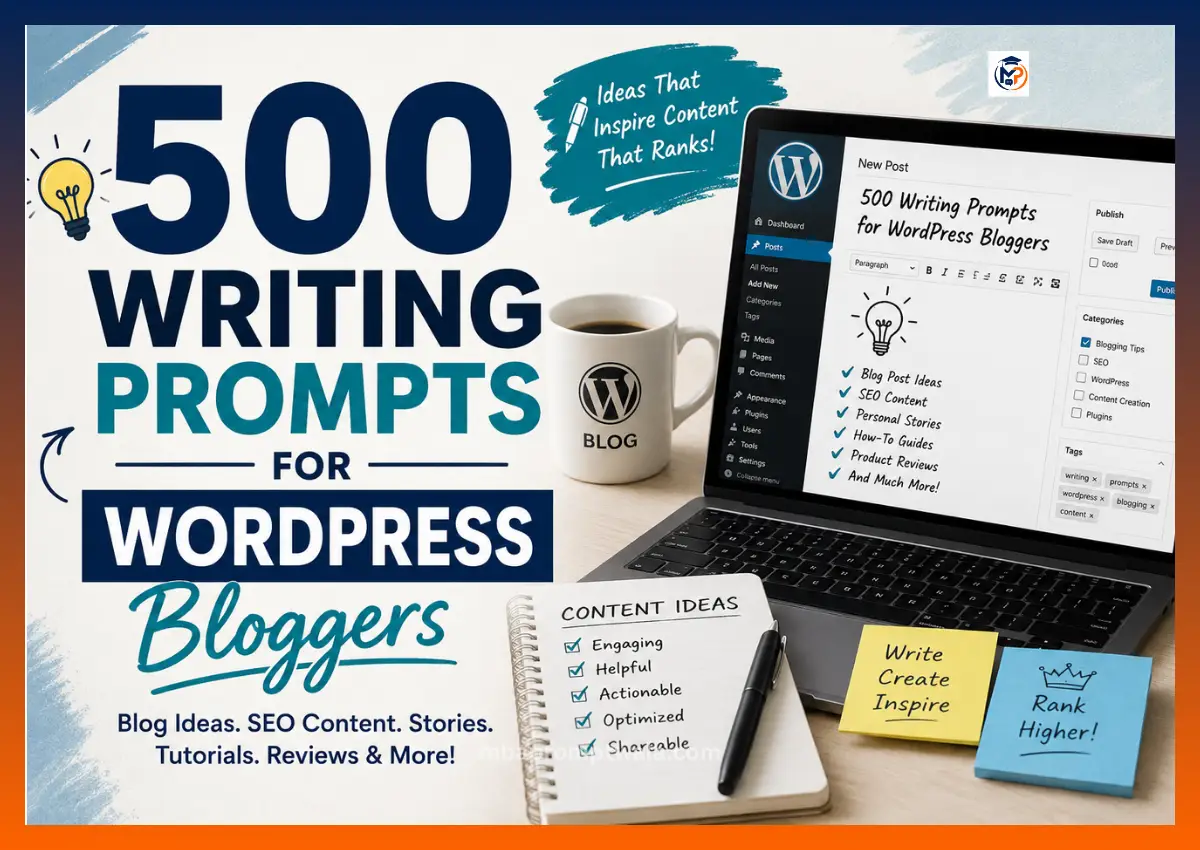
In this guide, you’ll discover 500 writing prompts for WordPress bloggers that can help generate blog ideas, improve articles, write faster, and overcome writer’s block. Whether you create tutorials, product reviews, personal stories, or SEO articles, these prompts will give you a reliable starting point.
You’ll also find 500 prompts for narrative and personal writing, practical AI examples, customization tips, and prompt-writing techniques that work with ChatGPT, Claude, Gemini, and other AI writing tools.
Why Every WordPress Blogger Needs Writing Prompts
Creating blog content consistently is one of the biggest challenges for bloggers.
Some days you have dozens of ideas.
Other days, you spend an hour thinking about a title.
That’s where writing prompts become valuable.
Instead of starting from a blank page, you begin with a clear direction.
Good prompts help you:
- Generate unlimited blog ideas
- Write faster
- Maintain a consistent writing style
- Improve SEO structure
- Reduce writer’s block
- Create more engaging articles
- Produce content readers actually finish
Whether you publish once a week or every day, having a library of prompts makes content creation much easier.
What Are Writing Prompts?
Writing prompts are simple instructions that help you start writing with a clear direction. Instead of facing a blank page and wondering what to write, a prompt gives you a specific topic, goal, or scenario to work from.
Think of a writing prompt as a roadmap. It tells you where to begin, but you’re still free to add your own ideas, examples, and personality.
Today, writing prompts are used by bloggers, marketers, students, authors, copywriters, and businesses. They also work exceptionally well with AI tools like ChatGPT, Claude, Gemini, and Microsoft Copilot because these tools perform better when they receive clear instructions.
The collection of 500 writing prompts for WordPress bloggers included in this guide covers everything from blog writing and SEO content to storytelling, marketing copy, and 500 prompts for narrative and personal writing, making it useful for almost every type of writer.
Traditional Writing Prompt vs AI Writing Prompt
Although both help you start writing, they serve different purposes.
| Traditional Writing Prompt | AI Writing Prompt |
| Gives you an idea to write about | Gives AI detailed instructions |
| Used by students and authors | Used with ChatGPT, Claude, Gemini, and other AI tools |
| Focuses on creativity | Focuses on producing useful, structured content |
| Usually one sentence | Can include context, tone, audience, format, and goals |
| You write everything yourself | AI creates the first draft based on your instructions |
For example:
Traditional Prompt
Write about your happiest childhood memory.
This is enough for a person to begin writing.
Now compare it with an AI prompt.
Act as an experienced lifestyle blogger. Write a 1,200-word personal story about a memorable childhood experience. Use a warm and conversational tone, include sensory details, describe what happened, explain the life lesson learned, and end with practical advice readers can apply today.
Notice how the second version gives AI much more context, resulting in a stronger first draft.
Real Examples of Writing Prompts
Here are a few examples that WordPress bloggers can start using immediately.
Blog Writing Prompt
Write a beginner-friendly blog post explaining how to speed up a WordPress website. Include common causes of slow loading, practical optimization tips, recommended plugins, and an FAQ section.
SEO Content Prompt
Create an SEO-friendly article targeting the keyword “best WordPress backup plugins.” Include comparison tables, pros and cons, expert recommendations, and a conclusion that helps readers choose the right plugin.
Personal Writing Prompt
Write about a mistake that completely changed your career. Explain what happened, what you learned, and how readers can avoid making the same mistake.
Narrative Writing Prompt
Tell the story of someone who unexpectedly discovers an old journal that changes the way they see their family history. Build suspense while keeping the emotional connection strong.
Product Review Prompt
Write a detailed review of a WordPress page builder. Discuss features, pricing, advantages, disadvantages, performance, ease of use, and who should buy it.
Listicle Prompt
Create a list of the 15 best free WordPress plugins for beginners. Include features, benefits, and ideal use cases for each plugin.
Why Good Prompts Produce Better Content
Many beginners believe AI writes poor content.
In reality, AI usually reflects the quality of the instructions it receives.
Imagine asking a designer:
Design something nice.
You’ll probably get an average result.
Now imagine saying:
Design a modern website banner for a technology blog using blue and purple gradients, minimalist icons, bold typography, and enough white space for readability.
The second request is much easier to understand.
Writing prompts work exactly the same way.
The more useful information you provide, the better the output becomes.
That’s why experienced bloggers rarely use one-line prompts. Instead, they explain the topic, audience, writing style, structure, desired length, and goal before asking AI to write.
50 Ready-to-Use Writing Prompts for WordPress Bloggers
1. Blog Writing Prompts
These prompts help you create informative and engaging blog posts.
| # | Prompt |
| 1 | Write a beginner-friendly guide explaining [Topic] with practical examples. |
| 2 | Create a complete “How-To” tutorial for [Topic]. |
| 3 | Explain the biggest mistakes beginners make when learning [Topic]. |
| 4 | Write a list of 15 tips to improve [Topic]. |
| 5 | Compare two popular solutions for [Topic] in a table. |
| 6 | Write an ultimate guide covering everything beginners should know about [Topic]. |
| 7 | Explain common myths about [Topic] and reveal the facts. |
| 8 | Write an article answering the most searched questions about [Topic]. |
| 9 | Create a step-by-step checklist for [Topic]. |
| 10 | Write a troubleshooting guide solving common problems related to [Topic]. |
2. SEO Content Prompts
Perfect for bloggers who want to rank on Google.
| # | Prompt |
| 11 | Write an SEO-optimized article targeting the keyword [Keyword]. |
| 12 | Generate 25 long-tail keyword ideas related to [Keyword]. |
| 13 | Create an engaging meta title and meta description for [Topic]. |
| 14 | Write an FAQ section answering common questions about [Keyword]. |
| 15 | Suggest internal linking opportunities for an article about [Topic]. |
| 16 | Rewrite this article to improve readability and SEO. |
| 17 | Generate H2 and H3 headings for a complete pillar article. |
| 18 | Suggest featured snippet opportunities for [Keyword]. |
| 19 | Create a comparison table readers can easily scan. |
| 20 | Write a strong conclusion encouraging readers to take action. |
3. WordPress Blogging Prompts
Designed specifically for WordPress content creators.
| # | Prompt |
| 21 | Write a beginner’s guide to installing WordPress. |
| 22 | Compare the best WordPress themes for bloggers. |
| 23 | Review the top WordPress SEO plugins. |
| 24 | Explain how to improve WordPress website speed. |
| 25 | Create a checklist for launching a new WordPress blog. |
| 26 | Write about common WordPress security mistakes. |
| 27 | Recommend essential plugins for new bloggers. |
| 28 | Explain how to optimize images for WordPress. |
| 29 | Compare free and premium WordPress hosting options. |
| 30 | Write a maintenance checklist for WordPress websites. |
4. Narrative & Personal Writing Prompts
These prompts are useful for storytelling, memoir-style articles, and reflective blog posts.
| # | Prompt |
| 31 | Write about a mistake that taught you an important life lesson. |
| 32 | Describe the day that changed your career forever. |
| 33 | Share a childhood memory that still influences you today. |
| 34 | Tell the story of overcoming your biggest fear. |
| 35 | Write about a mentor who inspired your journey. |
| 36 | Describe your first successful blogging experience. |
| 37 | Tell the story behind your biggest failure and what you learned. |
| 38 | Write about a difficult decision that changed your future. |
| 39 | Share a memorable travel experience with an unexpected twist. |
| 40 | Write a personal story that teaches readers a practical lesson. |
These examples are just a small sample from the 500 prompts for narrative and personal writing available in the complete collection.
5. Marketing & Social Media Prompts
Grow your audience with these content ideas.
| # | Prompt |
| 41 | Write five Facebook posts promoting a new blog article. |
| 42 | Create ten engaging Twitter/X posts about [Topic]. |
| 43 | Write an Instagram caption that encourages comments. |
| 44 | Generate LinkedIn content based on a blog post. |
| 45 | Create a Pinterest description using SEO keywords. |
| 46 | Write an email newsletter introducing a new article. |
| 47 | Suggest five lead magnet ideas for [Topic]. |
| 48 | Create a content calendar for the next 30 days. |
| 49 | Write a call-to-action that increases newsletter signups. |
| 50 | Repurpose a blog post into short-form social media content. |
Pro Tip: Customize Every Prompt
These prompts work best when you replace placeholders like [Topic] or [Keyword] with your own niche.
For example, instead of using:
Write a beginner’s guide about SEO.
Customize it as:
Write a beginner-friendly guide explaining local SEO for small restaurant owners. Include practical examples, common mistakes, recommended tools, and a checklist readers can follow.
That extra detail helps AI generate content that’s more relevant, useful, and closer to publication-ready.
500 SEO Writing Prompts for Bloggers
Prompt
Act as an experienced SEO content writer, content strategist, and subject matter expert.
Write a **100% original, human-like, SEO-optimized blog post of approximately 600 words** about **[TOPIC]** targeting the primary keyword **[PRIMARY KEYWORD]**.
### Writing Requirements
– Write for beginners using simple, easy-to-understand English (Grade 8–10 reading level).
– Start with a compelling introduction that naturally includes the primary keyword within the first 100 words.
– Use clear H2 and H3 headings that improve readability.
– Keep paragraphs short (2–4 sentences).
– Use bullet points or numbered lists where appropriate.
– Naturally include the primary keyword 3–5 times and related keywords throughout the article without keyword stuffing.
– Maintain a conversational, engaging, and trustworthy tone.
– Focus on solving the reader’s problem with practical, actionable advice.
– Avoid fluff, repetition, AI clichés, and generic statements.
– Include one real-world example or practical scenario to make the content more valuable.
– End with a concise conclusion summarizing the key points and encouraging readers to take action.
### SEO Structure
Generate the following before the article:
– SEO Title (under 60 characters)
– Meta Description (150–160 characters)
– URL Slug
– Primary Keyword
– 5 Related Keywords
### Blog Structure
1. Introduction
2. Main Explanation
3. Practical Tips or Steps
4. Common Mistakes or Best Practices
5. Conclusion
### Quality Checklist
Ensure the article is:
– Unique and plagiarism-free
– EEAT-focused (Experience, Expertise, Authoritativeness, Trustworthiness)
– Helpful and written for humans first
– Optimized for featured snippets where appropriate
– Free from unnecessary filler
– Factually accurate
– Ready to publish on a WordPress blog
Topic: **[TOPIC]**
Primary Keyword: **[PRIMARY KEYWORD]**
Also Read: