Hi, I’m Keshav Chouhan, and I love experimenting with AI photo editing using ChatGPT and other AI image tools. I regularly test creative photo prompts, traditional Indian looks, and realistic AI image ideas to find prompts that can help anyone create professional-looking photos without advanced editing skills.
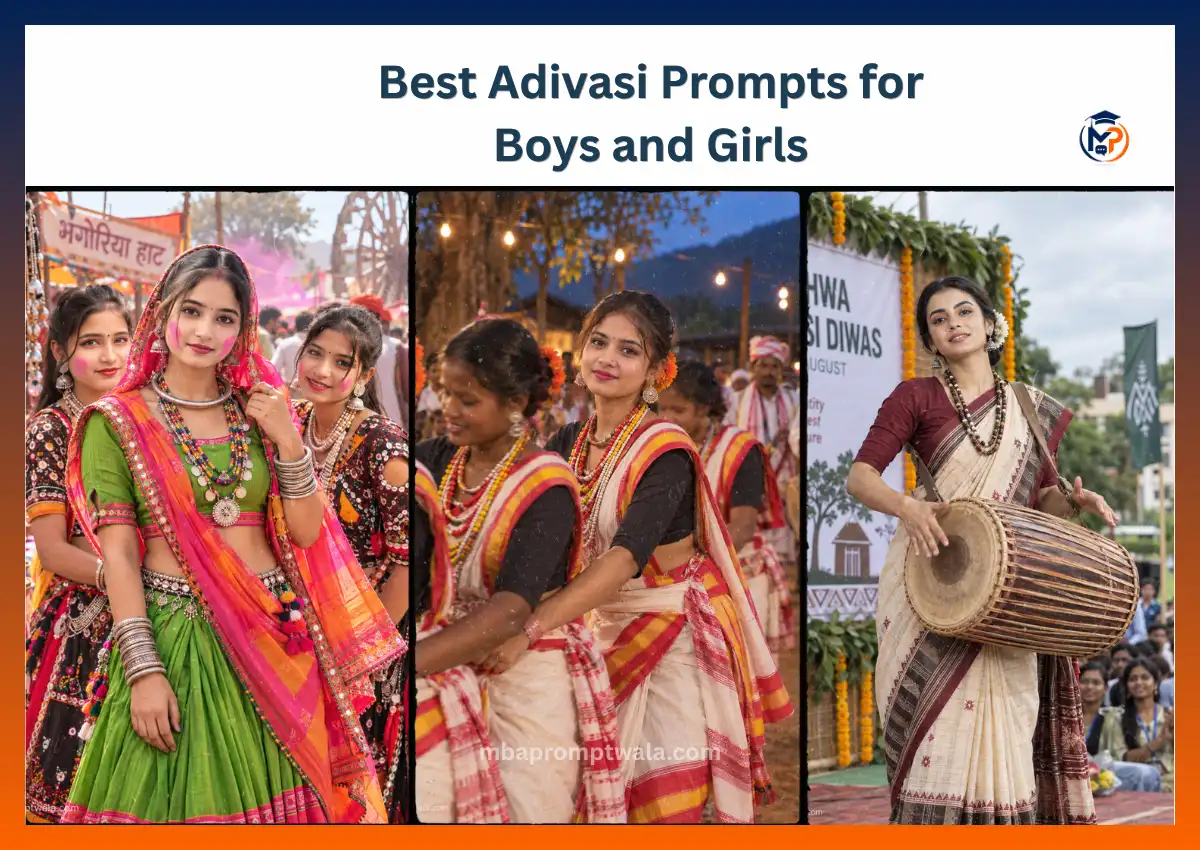
Lately, Adivasi Photo Editing Prompts for Boys and Girls have become a popular way to create unique traditional portraits with AI. From traditional clothing and jewellery to cultural celebrations, forests, village settings, and festival photography, these prompts can transform a simple photo into a powerful and realistic Adivasi-inspired portrait.
The biggest problem with many AI-generated Adivasi photos is that they often create a generic “tribal look” that doesn’t represent any particular community or tradition. The result may look visually attractive, but the clothes, jewellery, hairstyle, and cultural details can feel inaccurate or mixed together.
To create better results, I tested different ChatGPT and Gemini prompts based on real festivals, dates, traditional clothing, jewellery, locations, and cultural settings. I focused on details connected with occasions such as 9 August, Karma, Sarhul, Bhagoria, Sohrai, Hul Diwas, Dhimsa during Chaitra Parab, Bastar Dussehra, and Janjatiya Gaurav Divas.
In this guide, you’ll find Viral Tribal AI Prompts for Boys and Girls, including 5 prompts for girls and 5 prompts for boys. Each prompt is designed with specific clothing, jewellery, surroundings, poses, and cultural details to help you create more authentic and visually appealing traditional portraits.
Note: Simply upload your reference photo in ChatGPT or Gemini, copy your favorite prompt, and let AI transform your photo into a detailed traditional portrait.
What is an Adivasi prompt?
An Adivasi prompt is an AI photo editing prompt that places you in an Adivasi festival, dress or setting while keeping your face from the photo you upload. “Adivasi” means the original inhabitants and is the word many Indigenous communities in central and eastern India use for themselves: Santal, Munda, Oraon, Ho, Bhil, Gond, Baiga, Kondh and many more.
People search for these prompts most around 9 August (World Indigenous Peoples’ Day), Karma, Sarhul and Bhagoria. Adivasi students and young professionals use them for status updates, college event posters and profile pictures.
Adivasi Festival Calendar
| Festival | When | Where | Prompt |
| Bhagoria | 7 days before Holi (Feb to March) | Jhabua, Alirajpur, Dhar, Barwani, Khargone (MP) | 3 |
| Sarhul / Baha | Chaitra (March to April) | Jharkhand, Odisha, West Bengal | 2 |
| Chaitra Parab | Chaitra (March to April) | Koraput, Odisha | 5 |
| Hul Diwas | 30 June | Bhognadih, Jharkhand, and Santal areas | 8 |
| Bastar Dussehra | About 75 days, ending in October | Jagdalpur, Chhattisgarh | 9 |
| World Indigenous Peoples’ Day (Vishwa Adivasi Diwas) | 9 August | Across India | 1 and 6 |
| Karma / Karam | Bhado Ekadashi (22 September 2026) | Jharkhand, Chhattisgarh, Odisha, West Bengal, Assam | 7 |
| Sohrai | Around Diwali in Hazaribagh; January among many Santal villages | Jharkhand | 4 |
| Janjatiya Gaurav Divas (Birsa Munda Jayanti) | 15 November | Across India | 10 |
9 August is the United Nations’ International Day of the World’s Indigenous Peoples. In India it’s widely celebrated as Vishwa Adivasi Diwas, with rallies, cultural programmes and dances.
Getting the details right
Adivasi communities are different from each other. A Bhil girl at Bhagoria and an Oraon girl at Sarhul don’t dress alike, and the AI will mix them unless you name the community and the festival.
Leave out feathered war bonnets (those belong to Native American nations, not Indian ones), animal-skin clothing, face paint that isn’t part of the festival, and words like “wild” or “primitive”. None of that shows up at a real Sarhul or Karma, and Adivasi readers notice immediately.
Every prompt below also says “don’t lighten the skin”. Many AI tools lighten darker skin by default, and for a photo about Adivasi pride that’s the worst possible mistake.
Adivasi photo prompts for girls
1. Adivasi prompt 9 August for girls: campus celebration in a Kotpad saree
Kotpad handloom has a very specific look: deep maroon and brown from natural dyes on an off-white base, with small woven motifs along the border. If I only write “tribal saree”, ChatGPT gives me a random printed saree. The mandar drum also needs describing, or it turns into a dholak.
A 9 August campus portrait in handwoven Kotpad cotton from Koraput, Odisha, playing the mandar at a Vishwa Adivasi Diwas programme.
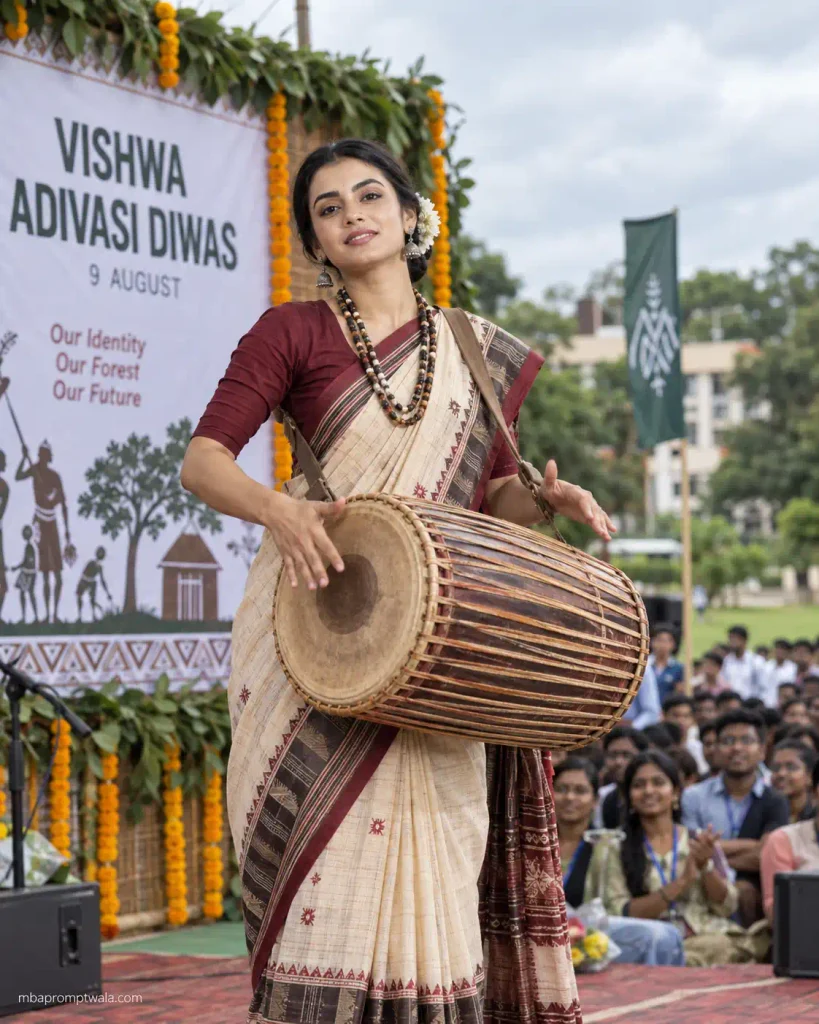
Use my uploaded photo as the only face reference. Keep her face exactly as it is: face shape, eyes, eyebrows, nose, lips, jawline, skin tone and moles. Do not lighten her skin or beautify her.
Create a photorealistic photo of this adult woman at a college Vishwa Adivasi Diwas programme on 9 August. She stands on a small outdoor stage decorated with sal leaves and marigold garlands, playing a mandar (a long, barrel-shaped clay drum with leather on both ends) hung from her shoulder by a strap. She is smiling mid-beat, looking at the camera.
Outfit: a handwoven Kotpad cotton saree from Koraput, Odisha, in natural maroon and dark brown on an off-white base, with small woven motifs along the border. A plain maroon blouse, a multi-strand bead necklace, simple silver earrings, hair in a bun with a few white flowers.
Background: students in the audience, softly blurred, cloudy monsoon sky, a green campus lawn.
Lighting: soft overcast daylight, even light on her face.
Camera: Canon EOS R6, 50mm f/1.8, natural skin texture with visible pores, true colours.
Vertical 4:5.
Add “mbapromptwala.com” as a small watermark in the bottom-left corner in thin, elegant white script lettering at low opacity.
2. Sarhul girl in a laal paad saree with sal flowers
“Sal flowers” alone gives pink or white random flowers. Sal blossoms are small, pale cream-yellow and grow in clusters, and describing them that way makes the scene read as Sarhul. The white saree with a red border (laal paad) is the most recognisable Sarhul detail, so I keep the red border wide.
A spring Sarhul portrait at the Sarna under the sal trees, dancing in a line with other women.
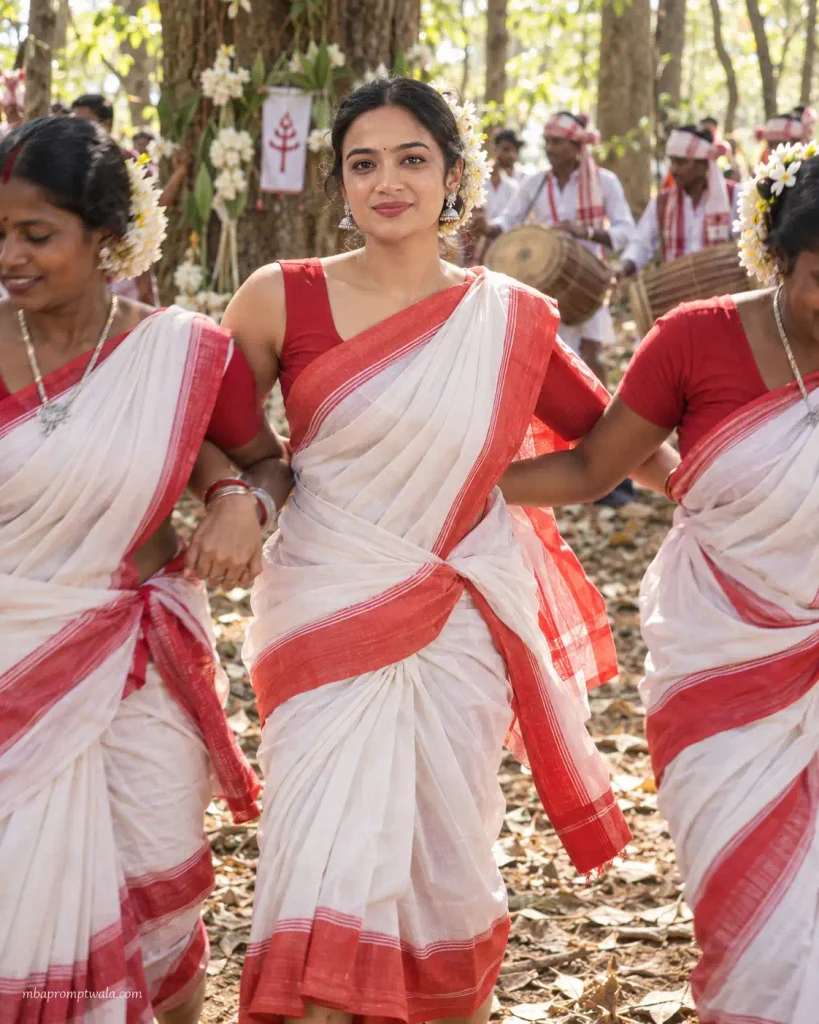
Keep the woman from my reference photo exactly recognisable: same face shape, eye shape, nose, lips, smile, eyebrows and skin tone. No smoothing and no skin lightening.
Create a photorealistic photo of this adult woman celebrating Sarhul in a Jharkhand village in spring. She dances in a line of women under tall sal trees, her arms linked with the women on either side, stepping forward with a joyful smile, face toward the camera. The other women are softly blurred.
Outfit: laal paad saree, plain white cotton with a wide bright red border, draped in the local style above the ankles, a red blouse. Clusters of small pale cream-yellow sal blossoms tucked into her hair bun and behind one ear. Simple silver earrings, a few glass bangles.
Background: the Sarna grove with tall sal trees, fresh light green leaves, men with a nagara and mandar drum in the distance, dry leaves on the ground.
Lighting: warm late-morning sunlight coming through the sal leaves, dappled light on the ground, her face in soft light.
Camera: Sony A7 IV, 35mm f/2, natural skin texture, warm true-to-life colours.
Vertical 4:5.
Watermark: “mbapromptwala.com”, bottom-left, small, thin white cursive, slightly see-through.
3. Bhagoria haat girl in silver jewellery (Jhabua)
Silver is the heart of this one. Among the Bhil, silver jewellery is a sign of prosperity, so I name each piece: a hansli neck ring, a bead galsan necklace, silver anklets. Without names, the AI adds gold, which looks wrong for Bhagoria.
The Bhagoria haat in western Madhya Pradesh, a week before Holi, with gulal, a giant wheel and a bright group of friends.
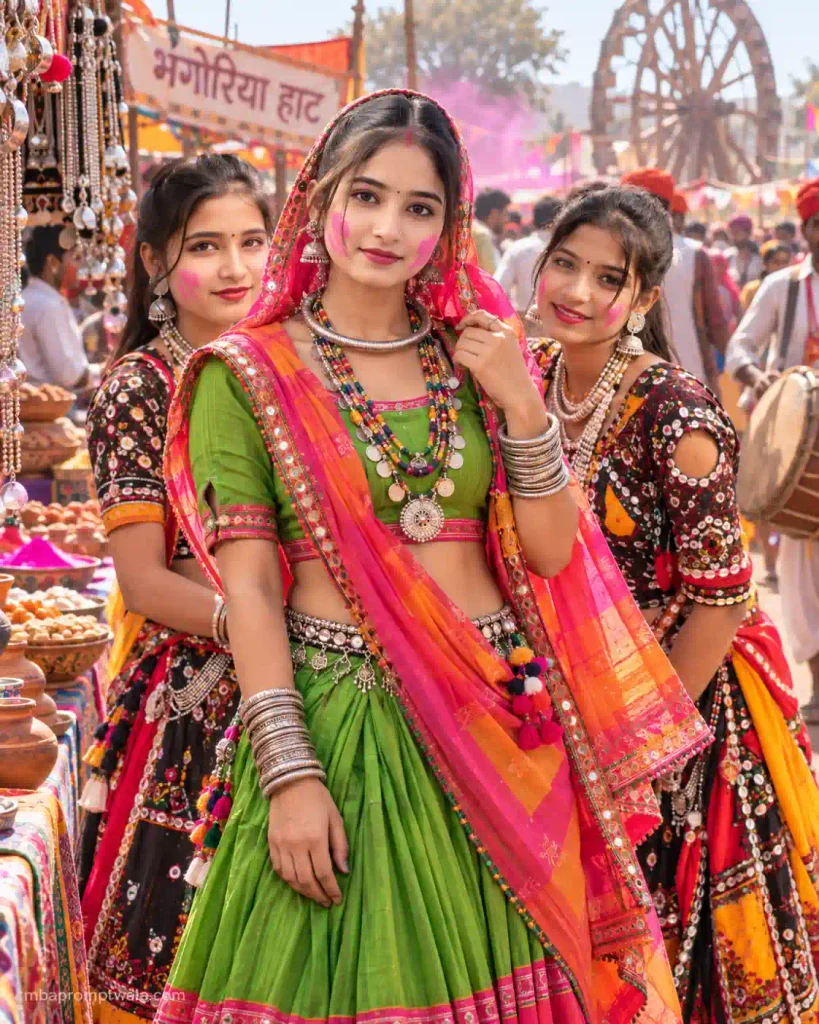
Use my uploaded photo for the face and keep it unchanged: face shape, eyes, eyebrows, nose, lips, jawline and skin tone. Don’t lighten or smooth her skin.
Create a photorealistic photo of this adult woman at a Bhagoria haat in Jhabua, Madhya Pradesh, a few days before Holi. She stands in the busy market with 2 friends dressed in matching colours behind her, softly blurred. Pink gulal marks on her cheeks, a playful smile, looking into the camera.
Outfit: a bright parrot-green ghaghra with a pink border, a matching blouse, and a pink and orange odhni over her head and shoulder, leaving her face fully visible. Jewellery: a heavy silver hansli neck ring, a colourful bead galsan necklace from Jhabua, silver bangles, silver anklets, a small silver nose ring.
Background: rows of stalls selling silver jewellery, clay pots and sweets, a large wooden giant wheel, dhol players in turbans, pink gulal in the air.
Lighting: bright afternoon sun, warm dusty haze.
Camera: Nikon Z6 II, 50mm f/1.8, real skin texture, bright but natural colours.
Vertical 4:5.
Add a small “mbapromptwala.com” watermark at the bottom-left in thin, elegant white script, low opacity.
4. Sohrai girl painting a mud wall mural (Hazaribagh)
This is the only girls’ prompt here without dancing. Sohrai art uses earth colours only, so I ban bright paint in the prompt. “Painting with her fingers” also comes out more real than a paintbrush.
Sohrai-Khovar wall painting from Hazaribagh, Jharkhand, holds a GI tag and is made by women on mud walls around Sohrai. This prompt puts you at the wall, mid-painting.
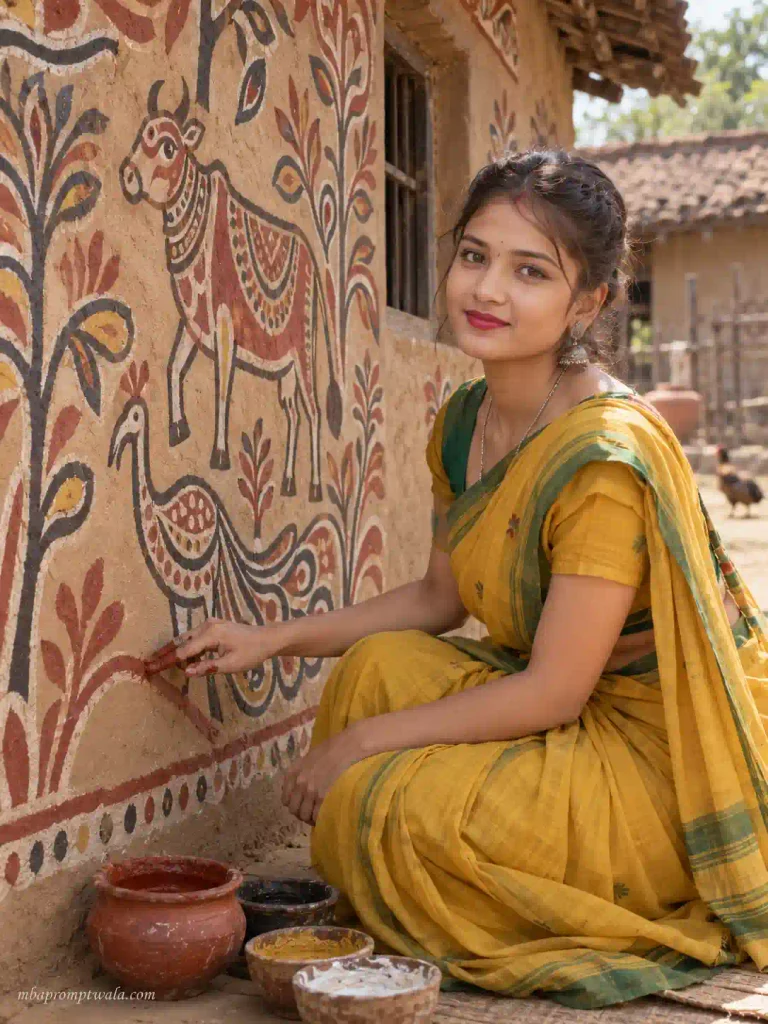
The woman in this image must be the same person as my reference photo: same face shape, eyes, eyebrows, nose, lips and skin tone. No beauty filter and no skin lightening.
Create a photorealistic photo of this adult woman painting a Sohrai-Khovar mural on the mud wall of a village house in Hazaribagh, Jharkhand. She kneels beside the wall, 2 fingers of her right hand dipped in red earth paint, drawing a line, and turns her face to the camera with a proud smile. Earth paint marks on her fingers.
The mural: bold outlines of a cow, a peacock, trees and flowering plants in earth colours only: red ochre, black, white clay and yellow ochre on a smooth brown mud wall. No bright synthetic colours.
Outfit: a plain cotton saree in mustard yellow with a thin green border, draped simply, a small silver chain, hair tied back.
Setting: a clay pot of paint beside her, a swept mud courtyard, a small window with a wooden frame.
Lighting: soft morning light from the side, showing the texture of the mud wall.
Camera: Fujifilm X-T5, 33mm f/1.4, natural skin texture, earthy colours.
Vertical 3:4.
Add “mbapromptwala.com” in the bottom-left corner as a small watermark in thin white script lettering, slightly see-through.
5. Dhimsa dance at Chaitra Parab (Koraput)
Dhimsa is danced in a long line with dancers holding each other’s waists or shoulders. The AI tends to space everyone apart unless I say “holding the waist of the woman beside her”. The necklaces need to be layered and chunky; a single thin chain looks off for Koraput.
Chaitra Parab in Koraput, southern Odisha, with the Dhimsa line dance and heavy layered necklaces.
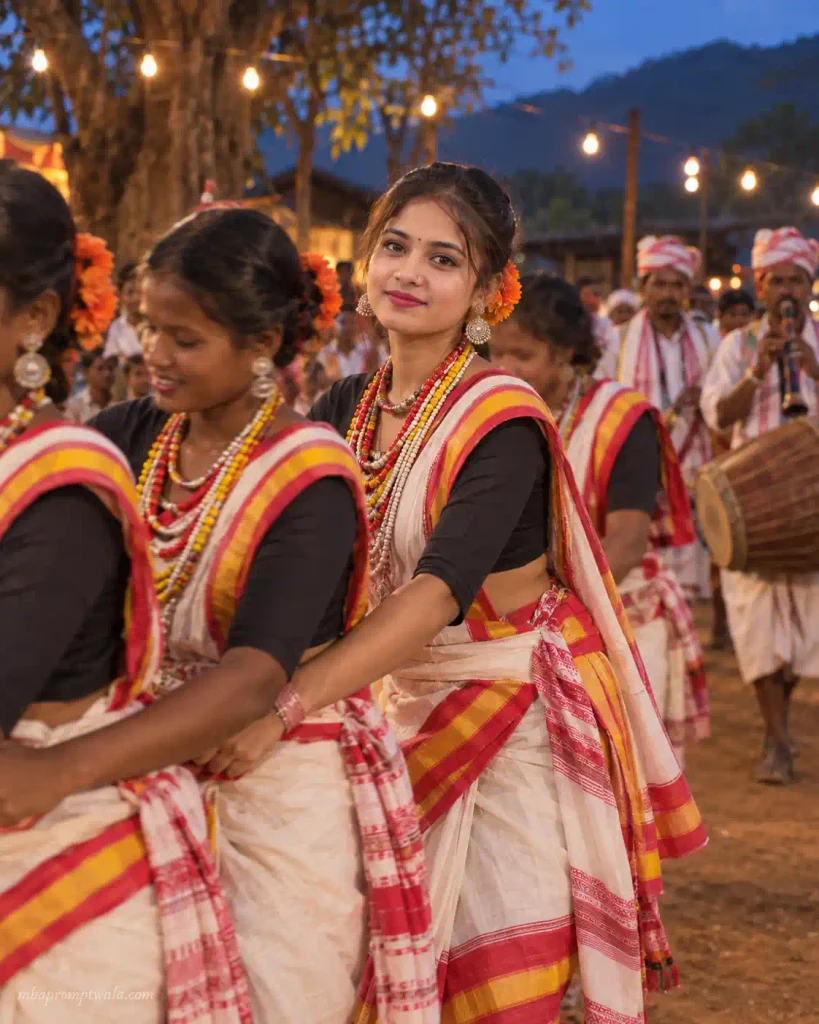
Take the face only from my uploaded photo and keep it the same: face shape, eyes, eyebrows, nose, lips, jawline and skin tone. Don’t beautify or lighten anything.
Create a photorealistic photo of this adult woman dancing Dhimsa during Chaitra Parab in a village in Koraput, Odisha, in the evening. She is in a line of women, her hands holding the waist of the woman beside her, stepping in rhythm. She turns her face toward the camera, laughing. The other dancers are blurred.
Outfit: a cotton saree in off-white with bright red and yellow stripes at the border, draped above the ankles, many layered bead necklaces in red, yellow and white, large round silver earrings, a small nose ring, hair in a side bun with orange flowers.
Background: a village ground, musicians playing a dhol and a mahuri (a small wind instrument), a large tree, a few string lights, hills in the distance.
Lighting: warm light from lanterns and string lights on her face, a deep blue dusk sky.
Camera: Sony A7S III, 35mm f/1.8, ISO 1600, soft grain, natural skin texture.
Vertical 4:5.
Watermark: “mbapromptwala.com”, small, bottom-left, thin elegant white script, low opacity.
Adivasi prompts for boys
6. Adivasi prompt 9 August for boys: Johar at the rally
A bow in the prompt can make ChatGPT draw an arrow pointed at the camera, which looks aggressive and can get the image blocked. “Unstrung bow resting on his shoulder, no arrow” keeps it a traditional symbol. The folded-hands “Johar” greeting gives the portrait a warm, respectful feel.
A 9 August rally portrait with the Johar greeting, a gamchha and a traditional bow on the shoulder.
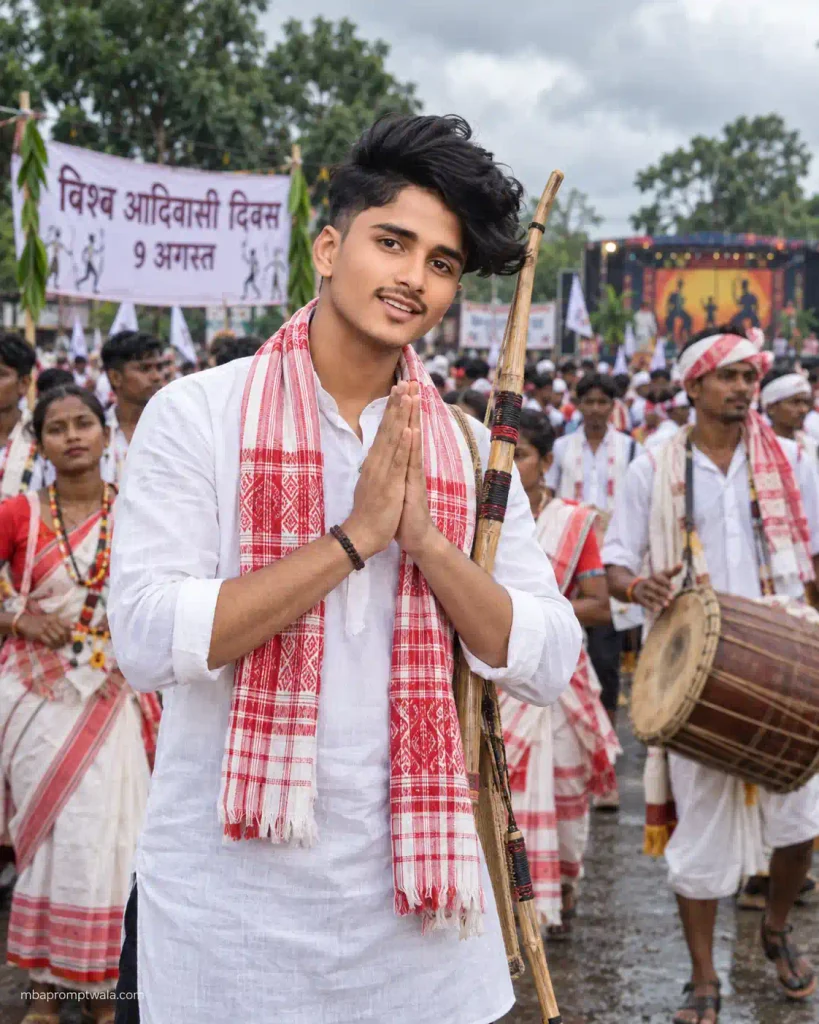
Use my uploaded photo as the face reference. Keep his face exactly the same: face shape, eyes, eyebrows, nose, lips, beard or moustache, hairline and skin tone. Do not lighten his skin.
Create a photorealistic portrait of this adult man at a Vishwa Adivasi Diwas rally on 9 August in a Jharkhand town. He stands at the front of the crowd with his hands folded in the Johar greeting, a warm proud smile, looking into the camera.
Outfit: a plain white kurta, dark trousers, a red and white checked cotton gamchha around his neck, a small bead bracelet. A traditional bamboo bow, unstrung, rests on his left shoulder. No arrow.
Background: a large crowd of young people, some playing nagara and mandar drums, others in traditional dress, marigold garlands, a stage far behind, monsoon clouds.
Lighting: soft overcast daylight, even light on his face.
Camera: Canon EOS R6 II, 35mm f/2, eye-level, real skin texture, natural colours.
Vertical 4:5.
Add “mbapromptwala.com” as a small watermark in the bottom-left corner in thin, elegant white script lettering, low opacity.
7. Karma night boy with the mandar
The Karam branch in the middle of the akhra is what tells people this is Karma, so it needs to be clearly visible behind him. Night firelight makes faces muddy, so I add a second light from a lantern on the other side. The mandar strap across the chest makes the pose look natural.
The night-long Karam dance around the Karam branch, with you on the mandar. Karma Puja falls on 22 September 2026.
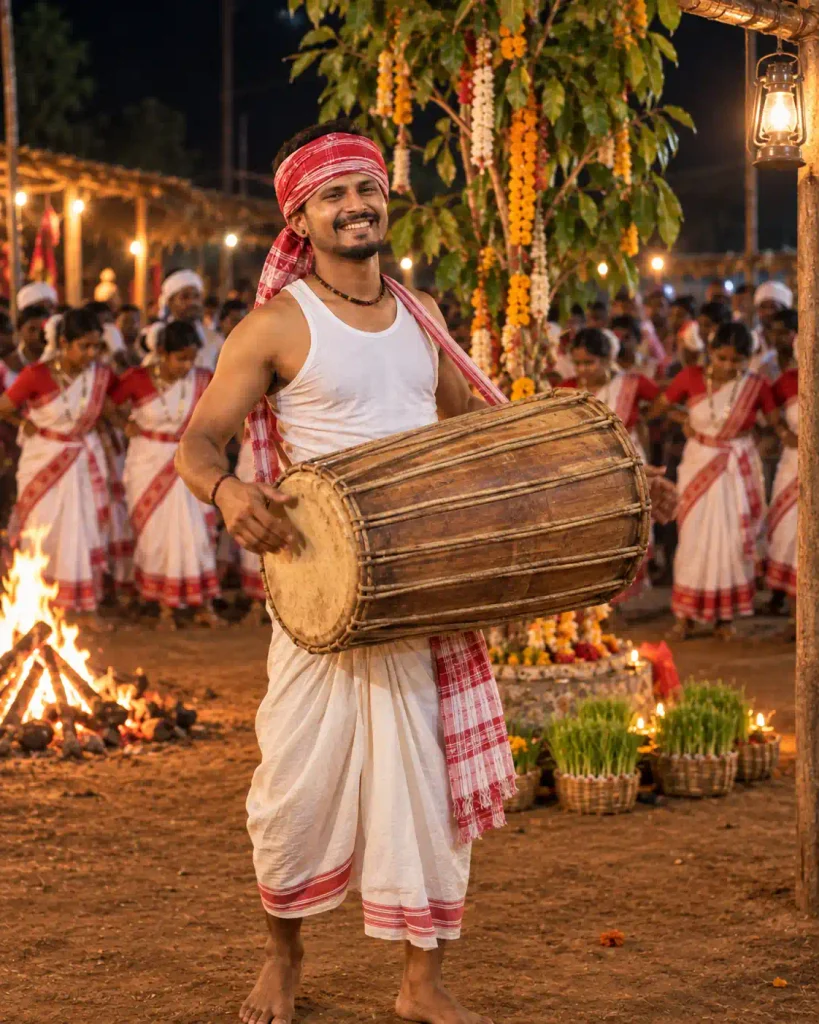
Keep the man from my reference photo fully recognisable: face shape, eyes, nose, lips, beard, eyebrows and skin tone. No smoothing, no reshaping, no skin lightening.
Create a photorealistic night photo of this adult man at Karma Puja in a Jharkhand village akhra (dance ground). He plays a mandar drum hung across his chest by a cloth strap, one palm striking each end, head tilted slightly, smiling at the camera mid-rhythm.
Behind him in the centre of the akhra: a Karam tree branch planted in the ground, decorated with flowers and small baskets of green jawa sprouts at its base. Women in white saris with red borders dance in a curved line around it, arms linked, softly blurred.
Outfit: a white dhoti and a white vest, a red cotton pagdi (turban) with a short tail, a red and white gamchha tied at the waist, a bead necklace.
Lighting: warm firelight from a small fire on the left, a hanging lantern on the right lighting the other side of his face, dark night sky.
Camera: Nikon Z8, 50mm f/1.4, ISO 2500, slight grain, sharp face, natural skin texture.
Vertical 4:5.
Watermark: “mbapromptwala.com”, bottom-left, small, thin white cursive, slightly see-through.
8. Hul Diwas tribute at Bhognadih
This needs a quiet mood, not a festival mood. I describe the memorial only as “a simple memorial with the busts of 2 brothers” instead of naming Sidho and Kanhu for the AI to draw, which keeps the faces from being made up. White flowers and no smile keep the tone right.
Hul Diwas on 30 June marks the Santal Hul of 1855, led by Sidho and Kanhu Murmu from Bhognadih in Sahibganj district. This is a tribute portrait, not a celebration.
Keep this man’s face identical to my uploaded reference: face shape, eyes, eyebrows, nose, lips, facial hair and skin tone. Don’t lighten or beautify him.
Create a photorealistic photo of this adult man on Hul Diwas, 30 June, at a village memorial in Bhognadih, Jharkhand. He stands in front of a simple memorial with the busts of 2 brothers on a pedestal, garlanded with marigolds. He holds a small bunch of white flowers in both hands, about to place them. Calm, serious expression, no smile, looking at the camera.
Outfit: a white dhoti and a plain white kurta, a green and white checked gamchha over one shoulder.
Background: other villagers in white and green standing quietly, softly blurred, a few men with Santal tumdak drums resting on the ground, green paddy fields and monsoon clouds behind.
Lighting: soft grey monsoon daylight, gentle shadows.
Camera: Canon EOS R5, 85mm f/2, shallow depth of field, natural skin texture, muted colours.
Vertical 4:5.
Add a small “mbapromptwala.com” watermark in the bottom-left corner in thin, elegant white script, very low opacity.
9. Bastar Dussehra rath pulling
The rath has to look huge and wooden, several storeys tall, or it turns into a small cart. Showing him leaning back on a thick rope with other men behind him gives the photo real movement. I keep the background crowd blurred so the face stays the focus.
Bastar Dussehra in Jagdalpur, Chhattisgarh, runs for about 75 days, and the giant wooden rath is pulled by men from the Adivasi villages of Bastar.
Use my uploaded photo as the only face reference. He must look exactly like me: face shape, eyes, eyebrows, nose, lips, facial hair and skin tone. No face changes and no skin lightening.
Create a photorealistic photo of this adult man at Bastar Dussehra in Jagdalpur, Chhattisgarh. He pulls a thick jute rope with both hands, leaning back with effort, laughing and looking toward the camera. A line of other men pull the same rope behind him, softly blurred.
Behind them: a giant wooden rath several storeys tall, with large wooden wheels, decorated with flowers, red and white cloth and small flags, surrounded by a huge crowd.
Outfit: a white dhoti tied at the knees, a sleeveless white vest, a red cloth tied around his head, a bead necklace.
Lighting: warm late-afternoon October sun, dust in the air, strong light on his face from the front left.
Camera: Sony A7 IV, 24mm f/2.8, low angle, slight motion in the crowd, face sharp, real skin texture.
Vertical 4:5.
Add “mbapromptwala.com” in the bottom-left corner as a small, thin white script watermark, slightly see-through.
10. Adivasi look photo boy prompt: Gond art portrait for Janjatiya Gaurav Divas
This is the “Adivasi look” editorial portrait most boys search for, done with a real art tradition instead of a costume. Gond painting has a clear style: animals and trees filled with fine dots and dashes. “Dots and dashes filling each shape” is the phrase that makes the wall look like Gond art and not generic folk art.
A studio-style portrait against a Gond painting wall from Madhya Pradesh for Janjatiya Gaurav Divas on 15 November, Birsa Munda’s birth anniversary.
Keep his face from my uploaded photo exactly the same: face shape, eyes, eyebrows, nose, lips, hairline, facial hair and skin tone. Don’t lighten his skin or beautify him.
Create a photorealistic editorial portrait of this adult man standing in front of a large Gond painting mural from Madhya Pradesh. The mural shows a big tree with birds, a deer and a peacock, each shape filled with fine dots and dashes in bright yellow, red, blue and green on a white wall.
He stands with arms loosely crossed, body turned slightly, confident calm expression with lips closed, looking into the camera.
Outfit: an off-white handloom kurta with rolled sleeves, a red and white checked gamchha tied as a short turban, dark trousers, a silver kada on one wrist, a thin bead necklace.
Lighting: soft studio light from the front left, a gentle fill from the right, clean shadows, evenly lit face.
Camera: Canon EOS R5, 85mm f/2, shallow depth of field so the mural is slightly soft, natural skin texture with pores, rich but true colours.
Vertical 4:5.
Add a small “mbapromptwala.com” watermark in the bottom-left corner in thin, elegant white script lettering, low opacity.
Tips for better Adivasi prompts
Name the community and the festival together. “Bhil girl at Bhagoria” and “Oraon girl at Sarhul” give 2 different, accurate photos. “Tribal girl” gives a costume.
Name each jewellery piece. Hansli, galsan, bead necklaces and silver kada all have a specific shape. Named pieces come out right. “Tribal jewellery” usually comes out as gold.
Describe instruments by shape. The mandar, nagara, tumdak and mahuri are not well known to image tools. A short description (“long, barrel-shaped clay drum”) gets them right.
Protect skin tone in every prompt. Keep the line “don’t lighten skin” even when you edit the prompt. If the result still looks lighter, use the fix-it line below.
Match the mood to the day. Bhagoria, Sarhul and Karma are celebrations. Hul Diwas is a tribute, so no smile and no bright colours.
Keep weapons symbolic. Bows and axes are part of some festivals, but always write “no arrow” and “resting on the shoulder”. Pointed weapons can get the image blocked or look wrong.
Fix-it lines
Paste these as a follow-up in the same chat. Each one changes 1 thing and keeps the rest.
| Problem | Paste this follow-up |
| Face doesn’t look like me | Keep the pose, clothes and background the same. Only correct the face to match my uploaded photo: face shape, eyes, nose, lips and skin tone. |
| Skin got lighter | Match the skin tone exactly to my uploaded photo. Change nothing else. |
| Gold jewellery appeared | Change all the jewellery to silver. Keep everything else the same. |
| Feathered headdress or face paint appeared | Remove the feathered headdress and face paint. Keep the rest of the outfit and the face unchanged. |
| Wrong saree for Sarhul | Change the saree to plain white cotton with a wide bright red border. Change nothing else. |
| Arrow pointing at camera | Remove the arrow. Keep the bow unstrung and resting on his shoulder. |
| Watermark missing | Add “mbapromptwala.com” as a small, thin white script watermark in the bottom-left corner. Change nothing else. |
How to use these prompts
- Open ChatGPT or Gemini and start a new chat.
- Upload a clear, front-facing photo in daylight, with no sunglasses and no beauty filter.
- Copy the full prompt and send it with your photo.
- Check the face, skin tone, jewellery and background before downloading.
- Use a fix-it line for small problems. If the face drifts after 3 or 4 fixes, start a new chat.
Also Read:
Best Ambedkar Jayanti Prompts For A Photos
Best Jay Bhim Prompts For Girls And Boys
FAQ
Which Adivasi prompt is best for 9 August?
Prompt 1 for girls and prompt 6 for boys. Both are set at real Vishwa Adivasi Diwas events: a college programme and a town rally.
Can I use these Adivasi prompts in Gemini?
Yes. Paste the same prompt with your photo. Gemini sometimes changes the watermark font, so check it before posting.
Why does the AI give me a feather headdress?
Many image tools mix up Indian Adivasi communities with Native American ones when a prompt only says “tribal”. Naming the community, the festival and each piece of clothing stops this. If it still happens, use the fix-it line.
Is it okay to use these prompts if I’m not Adivasi?
The prompts show real festival clothes, so wear them the way people at the festival would, and avoid sacred items or joke edits. If you post it, name the festival and community in the caption instead of calling it a “tribal look”.
Jay Johar Jay Adivasi.